Can you build a unicorn business outside the Silicon Valley?

This is a follow-on post to my last blog post about building a global-first startup

The tl;dr for my last post is that these days geography is rather confusing. It’s quite common for a San Francisco Bay Area company to start hiring from day one an engineering team that is elsewhere and building up a real hub elsewhere even though everyone sees them as a San Francisco company. Or for a startup located outside of the US to sell to US companies.  The world is a lot smaller than it used to be.  

And so for these reasons, I believe that to start a company, you can start building a startup these days from pretty much anywhere. The most important thing in the earliest stages is to try to get to product Market fit quickly.

Knowledge has become commoditized at the earliest stages – you can pretty much read about Lean Startup anywhere on the internet.  But what about scaling a business? 

The numbers are actually pretty sobering.  I went ahead and graphed some interesting fundraising data from past portfolio companies that I’ve invested in either as an angel or as part of a team where I was a/the decision maker.  

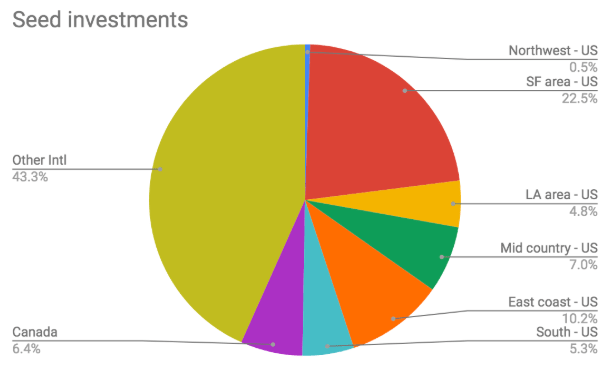
I took my whole portfolio of all companies that I had invested in between 2014-2016 and created pie charts based on geography. N = over 250 companies in this dataset.

Screen Shot 2019-08-30 at 2.30.52 PM
You can see the vast plurality of companies that I invested in during this time were largely international companies  Note: for the purpose of this exercise, I separated out my Canadian startups from the rest of the world. (Canadian startups are so similar to US startups that I thought they deserved a category of their own.)

I did the best job that I could in labeling just one geography for each startup, but this exercise was a bit tricky. For example, a company that I had invested in is categorized as a San Francisco-based company even though the vast majority of their employees are now based in Dallas. The reason for this is that when I invested in them, the founders were and still are based in San Francisco, and the bulk of their decision-making and operations were happening here at the time.  On the flip side, I classified a number of companies whose founders had recently moved to the US from another country and were doing significant operations in that other country as “other int’l”, even if they were US Delaware C corps. As you can see per my last blog post, it gets a little bit complicated. 

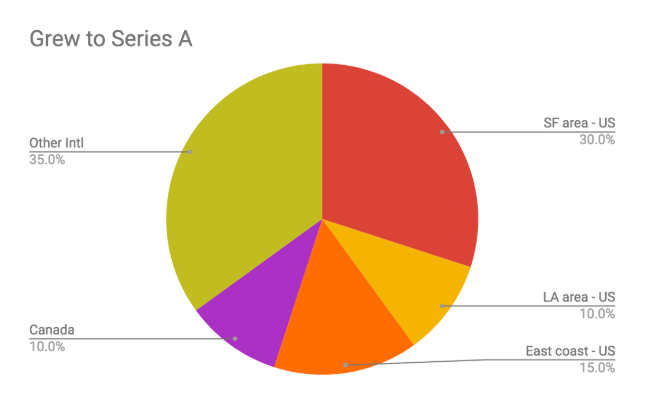
I then went ahead and grabbed the companies that made it to the Series A level and graphed what the breakdown of those startups look like by geography.  The reason I say Series A level is that I have a number of portfolio companies who have done well in revenue and have not had to raise larger rounds.  So if a company had raised a series A, I labeled the company as a Series A company regardless of where the raise happened. Now, I understand that there are some issues with the nomenclature because a Series A in the Bay Area is so much later than a Series A in say Australia, but, this was the best I could do. In addition, if a company had not raised a Series A but had hit US Series A milestones – namely $2m+ “net revenue run rate”,  then I counted the company as a Series A company.

Screen Shot 2019-08-30 at 2.34.47 PM

What is interesting about this graph is just how much the percentages have changed.  Let’s come back to the analysis in a second.

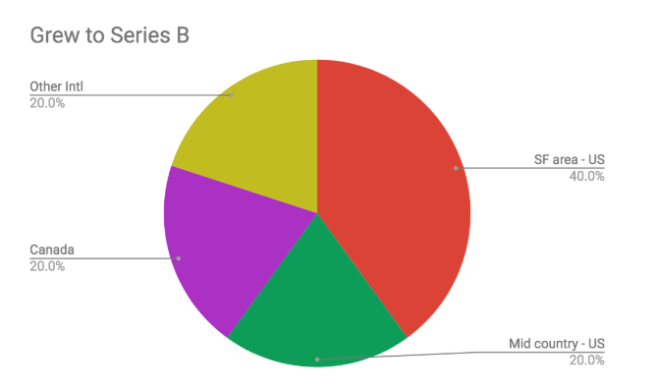
I went ahead and did the same exercise with Series B companies.  I graphed my portfolio that had graduated to the Series B level. And again, for companies who raised a Series B – whether here in the US or abroad — were labeled a series B company.  For companies who had hit US Series B traction milestones – namely 10m+ annual net revenue runrate – I also added those companies to this category as well.

Screen Shot 2019-08-30 at 2.35.57 PM.png

You can see that this graph has changed even more.

Here are my takeaways: 

1) The San Francisco Bay Area punches above its weight. (not surprising)

One could try to argue that perhaps my San Francisco Bay Area founders are stronger. While I couldn’t tell you whether that’s true or not, intuitively, my gut feeling is that that is not the case.

What I do think is happening here is that the San Francisco Bay Area has a lot more capital, and so there are more startups that get more funding than in other parts of the world. And by proximity of being here, it is easier to access the capital (even though there is also more competition).

But the other thing that I think is happening is access to talent and knowledge, especially as companies scale. I tend to invest in businesses that require less capital. This tends to skew towards B2B companies or other businesses where the margins are nice. I tend to prefer investing in companies where if they could never raise a dime of VC funding again, they would still be able to survive and thrive.

And I’ve applied this lens across all geographies. So as a result, I would not expect such wild differences in ability to get to the Series A level or the Series B level even if there is less capital available in other markets. But you can see that there is a big difference.  

1b) One side note: also, if I remove startups who have founders with pedigree, then SF doesn’t punch above its weight and proportionally stays the same at each stage. 

2) International companies outside of the US & Canada have a much harder time raising money.

You can see that across-the-board, my international companies have had really had a tough time getting to the Series A or Series B level.

And again, I attribute this to less access to knowledge about scaling, less access to capital, and less access to talent that has scaled businesses before. One potential wildcard explanation for this lack of success is that the US & Canada have pretty established customer acquisition channels.  But, that isn’t the case everywhere globally, so it may also be that customer acquisition makes marketing and sales in the US & Canada just faster and that other international companies just need more time to make headway.  

3) Companies based outside of the SF Bay Area that have been successful have spent significant time in the Bay Area

The last interesting thing I would say here is that if you look at the Series B companies, anecdotally I can tell you that all of those founders have cultivated lots of relationships here in the SF Bay Area to get scaling knowledge and access to capital.

Takeaways:

I don’t think you need to be in the San Francisco Bay Area to start a company. In fact, I actually think that since your money goes so much further elsewhere and knowledge is commoditized regarding starting a business.  As an early stage founder, you really should just focus on product-market fit wherever you feel is best for you to live.

BUT!  If you want to start scaling a business – call it at the Series A level and beyond – that’s when you really need to start having connections ideally to the SF Bay Area to raise money from and have a network / learn from and potentially even a pool of people to hire.  

unicorn

Image courtesy of Giphy

If you are starting a business outside of the Bay Area and want to build a unicorn business, in today’s global economy, it is significantly helpful for you to start building from connections on day 1 to the SF Bay Area.  

The rise of the global first startup

In the past 5 years, there have been a lot of changes in the startup ecosystem. One of the big changes is in geographical activity. 

At Hustle Fund, we invest in early stage startups that are in the United States, Canada, and Southeast Asia. We do this all with one fund. And often we get asked, why don’t we start regional funds?  To be honest, this is something that we had thought about very deeply. But what we are seeing in the startup ecosystem today is that startups are global from day one. And that the concept of a “regional fund” doesn’t make much sense anymore or at least is too nebulous.

5 years ago, if you were building a startup, you would be crazy to try to be “global first” startup. If you were building your team in other countries or even other cities, that seemed like a bad idea. If you were trying to sell a product to customers elsewhere, that also seemed like a bad idea. Specifically, the reason why this seemed like a bad idea is that it seemed like the logistical challenges in coordinating with other people would just be so cumbersome that it would negatively affect your business. These days, I would argue that you’re at a disadvantage if you are not a “global first” startup.

giphy-1

Photo credit: Giphy

Most 2019 unicorns are in the United States and China.  And, these companies were largely started in the United States and China and grew up in these places. I believe that we will continue to see this trend. But, if you look at say the the up-and-coming San Francisco based companies that will become unicorns in the next couple of years, many of them were not started in San Francisco.  Many of them were started elsewhere OR have significant offices elsewhere. If you dig into this list of up-and-coming unicorns, not only do you see a number of companies that are based elsewhere, but you see companies like Front or HackerOne labeled as San Francisco companies though they started got their foothold elsewhere. 

This matters, because how startups get their foot on the first rung of the ladder is what enables them to get going. If you can reduce your costs on engineering talent and manage teams well from the beginning, you can take your company a lot further for the same amount of money.  I recently caught up with two past portfolio companies, and I was floored that both of them were doing $5m ARR with fast growth and had raised very little seed funding. If you were to look at their cap tables, one had sold less than 10% of their cap table on a fully diluted basis and the other had sold less than 10% of their business fully diluted. Their next raise will probably be mega series B or C equivalent rounds and will have experienced much less dilution than your typical fast growth startup that starts and grows up in San Francisco. I asked them, “How were you able to build and sell so much with so little?” That’s when I learned that both companies had engineering teams elsewhere. Their engineering teams were in Vietnam and Argentina respectively. Both teams had a technical co-founder leading product outside of the United States. And both teams had customer acquisition teams based in the United States – sales, marketing, and business development.

When I look at my Hustle Fund portfolio, which is newer, I also see the same trend. Even if not hiring abroad, my companies are hiring outside of San Francisco. One of my current portfolio companies who has actually raised a lot of cash and is based in the San Francisco area has more employees in Dallas than here. You would not know that by just looking at the company as an outsider.  To most people, they seem like a regular, ordinary San Francisco-based company. I have other portfolio companies that are also on a fast-growth trajectory who from day 1 started building teams elsewhere as well. One of my fast-growing B2B companies has more employees based in Nepal than here in the San Francisco Bay area, and they are a SF-based company. We have portfolio companies who have engineering and operations teams in places like Bulgaria, Canada, and Nigeria. By hiring talent and managing talent outside of San Francisco, companies can see a 3-5x difference in cost than hiring in San Francisco.  Roughly speaking, this means that you can extend your runway 3-5x longer which is huge when you are trying to find product-market fit or make a big enterprise sale that won’t happen for 2 years. 

I think five years ago, there was this notion that technical talent in San Francisco was stronger than elsewhere. I think that is only true when you’re talking about the top 1%. It’s not because San Francisco naturally breeds smarter people, but it’s because you have companies like Google and Facebook who are willing to pay $1m+ per year to attract that global talent to the Bay Area in the first place. But, can startups woo that 1% talent away from Google and Facebook? And my hypothesis is that only in rare cases can this happen.  Startups can’t compete with the GOOG on comp or benefits. And, I’m seeing most of this talent either starting their own companies or working for a friend’s very promising company. 

And so most SF Bay Area startups are not able to hire this talent — they are hiring good talent for sure. But you can hire good talent elsewhere too for lower salaries.  I think sometimes we think that the more you are paid, the better you are, but that is actually not true. How much you are paid is largely related to the cost of living of where you are. In parallel, what we are also seeing are two other trends.  1) Knowledge is becoming more and more of a commodity. You can find all kinds of free information on the internet on how to do just about anything. 2) We are also seeing a lot of tools coming up to make development easier or in some cases, allow you to build things with no code.  If you are building a “deeptech” startup, then you do need to hire the best technical talent in many cases, but most say typical B2B startups that are coming up don’t need particularly deep technical knowledge. So, you can get the same level of talent quality for a fraction of the cost in places where the cost of living is cheaper.  

Now, hiring people in multiple locations certainly has a ton of challenges. It is challenging to build rapport with people remotely. And it is challenging just to get people to work together remotely. I think all of these challenges still apply even now but are a bit easier than 5 years ago.

Over 5 years ago, remote communications was a challenge.  Nothing really worked well. I remember Skype and Google Hangouts being just sh*tty.  (They still are) I hired remotely for my startup, and I was one of the early users of Zoom for my startup LaunchBit. Prior to that, we had tried just about every video conferencing software possible, and nothing worked well.  But, with Zoom, we gave everyone an iPad and had everyone just leave Zoom on all day everyday. The calls *never* dropped. And there was never any latency. It was like we all sat in the same room. Today, we also have Slack, which has made communication so much easier.  And a lot of wiki-like tools.  

What I have seen work the best with regard to tight communications, is to build a hub-and-spoke model. For most of my portfolio companies, they have distinct offices in specific places. They build out teams in these places, and there is a team leader of sorts in each place.  Usually a co-founder who had spent time in the US and met the US-based co-founder and then returned home to build the team. And it is the team leaders who need to coordinate the best remotely. E.g. it is the technical co-founder who coordinates really well with the business co-founder to test hypotheses together to get to product-market fit. And they have really quick feedback loops. So then you’re not really talking so much about coordination of many people, but you are talking about the coordination of a couple of people.

Building culture, though, is the tricky part. How do you ensure that each team has the same culture? And that’s hard. I don’t have a great answer for this. even when I worked at a large company – Google – I noticed that the culture was different in the Boston office than at headquarters in Mountain View. This isn’t a bad thing, but it is challenging to have to ensure that all teams have the same culture.

Beyond working with teammates globally, we also have portfolio companies who are doing some crazy global arbitrage things. For example, in Canada, the government offers startups so many grants of all kinds. And that reduces the costs dramatically or reduces the need to take dilutive funding. In contrast, in the US, most software startups do not qualify for any grants.  One of my San Francisco-based teams actually set up a Canadian entity just to take advantage of one of these grants. 5 years ago this might have seemed like a weird distraction. But today, this type of arbitrage can buy you a couple of extra years of runway or reduce your need for dilutive capital.  

On the business side, we have US portfolio companies who are now selling to potential clients in Asia. and we have Southeast Asian companies who are selling globally or to the US market. Five years ago, this seemed impossible but today, this makes a lot of sense for the right business. 

How can you sell abroad? I see most of my portfolio companies or past portfolio companies building out their customer acquisition team in the market they are selling to. But even in the beginning when it’s just the co-founders, this is possible too.  Even many years ago, when I was selling ads for my startup, my customers were in India and Israel and Europe . And, I made all of those sales over the phone or over video conference. In fact, those sales were done in the same way that I sold to US customers. The only difference is that sometimes I would have to stay up and make those sales or get up early in the morning.  In fact, some of my current portfolio companies are finding that it is actually easier to sell to customers in another geographical market. Customers in another region of the world may be hungry for technology in a way that local customers may not — especially when you’re building to disrupt old stodgy industries. Sometimes finding product-market fit is tied to to geography.

So when I look at our portfolio, I cannot quite “bucket” so many of my companies. I have companies that are San Francisco-based but have operations or development in another country or another city.  In other cases, we have Singaporean companies that sell to the US. What it means to be say a “San Francisco-based company” is quite nebulous these days.  

In fact, when I previously was running an accelerator in a past life, in one of my batches, I had a portfolio company with a co-founder who was from another country X and had a development team in country X.  But the company was incorporated in the US and both co-founders lived in the SF Bay Area. My past employer also had a regional fund that invested in companies in country X. And, the fund manager for country X was a bit ticked off at me at first for not showing him that deal.  

I was puzzled, “But they are a US company and the co-founders live here — I thought you are investing in startups in country X.” I said. 

“But the founder is from country X and they have a team in country X,” he said. 

That was the first time I started thinking about this issue. My mind raced through all of our companies in the accelerator batch and past batches. It dawned on me that most of the companies in our accelerator were US companies (SF based) who had teams elsewhere and that geography had become blurred.  That was a few years ago, and now it’s even more blurred. 

In this modern economy, if you can navigate hiring and building teams in different locations and selling to customers in other areas, you are at a serious advantage. And in many cases, I think in the next 5 to 10 years, I think this will become not only a nice to have skill set but a necessary skill set. 

What questions will early stage VCs ask you?

I thought it might be helpful to create a live running Google Doc of all the major questions that a VC might ask you.

Go to -> Questions that a VC might ask you.

If there are more questions you think I should add to this list, please comment in the Google Doc, and I’ll add additional ones that get multiple votes.

I’ve highlighted in blue the questions that I care the most about. I’ll certainly ask questions about traction just to get an understanding of what has been done in the company, but as a pre-seed investor, we do most of our investments pre-traction. This will, of course, be different for a seed or mango-seed investor.

What is most interesting to me in looking at all the questions I’ve highlighted in blue is that you can see I very much gravitate towards customer acquisition questions.  It isn’t so much that I care about what your LTV and CAC are today.  In fact, in most cases, your CAC will only go up (significantly) and your LTV will hopefully be worth more in the future, so it doesn’t mean anything to me! But I want to understand how you think about getting customers.

customerservice.gif

Credit: Giphy

Most entrepreneurs at the pre-seed stage haven’t thought much about customer acquisition. In my view, this is what separates savvy or experienced entrepreneurs from everyone else.

The savviest or most experienced entrepreneurs will often think through the customer acquisition first before even thinking about the product.

At this stage, no one will have all the answers, but a great entrepreneur will think through things like “is this problem important enough that customers will part with their money for this?” and “what is my wedge into this market to beat out alternatives / competitors?”  The savviest or most experienced entrepreneurs will start pre-selling ahead of having a product and know that these results are more telling than surveys.  These are the kinds of things that I want to understand at the pre-seed stage.

What questions do you think should be added to this list?

Some thoughts on balancing family and a startup

One of the more taboo topics in “Startupland” is around having a family while starting a business.  When I was about to have my first child while working on my company LaunchBit, I was catching up with a friend of mine who was also an angel investor in my business.

And then he asked me, “How do you think about balancing your company with a young child?”

Since then, it’s a question I’ve batted around for years.  Is this an appropriate question?  Is it even a good question?  And what is even an answer to this question?

To be clear, my friend didn’t mean any malice by it nor was he trying to use my answer as a piece of information in making a decision about investing — he was already an investor. He was just legitimately curious. But of course, the immediate counter question that comes to mind (and that I articulated out loud) is, “Would you have asked me that question if I were a male founder / CEO?”

We all know that he wouldn’t have.

For as long as I’ve been running my own company — first at LaunchBit and now at Hustle Fund — I have not often engaged in conversations about family in business meetings / business settings.  When other people talk about their kids, I usually just kinda smile and nod.  In contrast, my business partner at Hustle Fund Eric often talks about his family and his minivan.  He shares photos of his children with our investors in our monthly reports regularly.  I don’t think think most of our investors even know that I have children.  There is an unspoken looming fear that many female entrepreneurs with children have — that their abilities and dedication as a professional will be judged and looked down upon because they have children.  This is because there is a notion held by some people in the ecosystem that having a startup while having children puts you at a disadvantage and shows a lack of dedication.  Obviously, not everyone holds this belief, but there is no upside as a woman to sharing that you have children while running a startup.  And so for so long, I’ve just generally kept quiet / private about the whole matter.

And I’m not the only woman to do this.  Countless female founders of mine over the years have asked me for advice and guidance on managing a family while starting a company but have also asked me to keep these questions on the down low or even their plans to start a family on the down low.  I’ve become a confidante of sorts because I’m a female founder with a family in this taboo world.

However, after mulling on this for a few years, I think the exact opposite needs to happen.  Everyone would benefit by sharing advice on tips for handling parenting while running a startup.  And, so I’ve decided to write this post on how I’ve managed to balance parenting while running 2 startups (had kid #1 while running a product startup and had kid #2 while starting a VC fund a couple years ago).  

Before I had kids, I had in my mind an idyllic notion of parenting.  I thought I would swaddle my newborn in cloth diapers, feed breast milk for a year, and follow every other piece of advice from “ideal mother” websites. But then, reality quickly set in – in having my first child while running my adtech company.  The idea of spending an extra 30s putting on a cloth diaper at 2 in the morning in a half dazed stage all of a sudden seemed less exciting — my stance on parenting immediately changed when I became a parent — I just wanted to make sure my kid stayed alive and healthy! 

The reality check

On one hand, there is truth to why running a startup and raising children isn’t easy.  Many people will say that it’s because children take up a lot of time and attention.  Other people say it’s because they increase your financial burden. Both are true but IMO not the biggest issues namely because people are incredibly resilient to constraints — both time and money constraints.

For example, before I had children, I thought I was quite efficient with my time. Post-children, in looking back, I’m actually 3x+ more efficient with time now. I never thought I could eke out so much more efficiency. You can ALWAYS become more efficient with more constraints.

bejewled.jpg

Playing Bejeweled is something I used to do but don’t anymore…

So, the biggest challenge isn’t additional constraints, because resilient people make things work and make them work better.  I actually think the biggest challenge is that there are just a lot more variables that are out of your control.

For example, your kid gets sick and can’t go to school; that’s out of your control. Your kid wakes up every two hours; you can’t control that either. So how do you deal with last-minute situations? How do you impromptu handle situations you didn’t expect? 

So, here are some key things I’ve learned while leveraging my time as an entrepreneur parent:

  1. You need support. Don’t do it alone.
  2. You need to say no and leverage time.
  3. You need to “let go.” 

Support

It really does take a village to raise children, and I’ve leaned on tons of people for support from the beginning through now. I think people are often afraid to do so, but I think it makes life a lot easier. 

During the first few weeks of motherhood, folks showed up with home cooked food or bought meals / meal gift certificates for me and my husband. Beyond the warmth of love and generosity this brought us, such a little act made a big, practical difference in my day. I could then put my energy towards thinking about my business, focusing on my kid, and even some personal recovery time, instead of worrying about what we were going to eat for dinner. On the flip side, this is probably the easiest, best gift you can get a new parent — meals.

My support network helped me balance time as I became a first and then later second time mom while being an entrepreneur. When my kids were still very young, friends and relatives babysat while I went to networking events, to work, or to sleep when I desperately needed a nap. For example, when I was fundraising for Hustle Fund in 2017, there was a networking event on a Saturday in San Francisco, and my husband was out of town.  For the 2-3 hours that I was there, I left my baby with my friends who lived in the Mission.  As an entrepreneur, at work, you ask for the moon from your business partners and potential clients all the time.  But we don’t often do that with people we’re closest with.  Why not?

My husband holds down the fort a lot, especially when I travel for work or have late meetings or events.  And my parents have spent so much time with my kids when they have no school (and in the very beginning when they couldn’t go to daycare), I can’t imagine accomplishing both startups without them or my extended support network.

Pride is one thing you really can’t afford when launching into the role of a entrepreneur-parent. 

Saying no & leveraging time

As a parent and entrepreneur, I need to leverage my time, and I need as much of my 9am-5pm working block to be free to think / write.

To achieve this, unfortunately, this means I end up saying “no” to a lot and moving things to more efficient channels whenever I can.

For example, people ask other people for coffee meetings a LOT!  Usually without any purpose. I used to do these coffee meetings a lot in my 20s. But, now, I often say “no” to coffee meetings. Critics of this strategy may argue, “Well, I’ve built my best connections through coffee meetings.” And I can agree coffee meetings are great to a) re-build or strengthen rapport with someone you already know / want to catch up with a friend OR b) meet with someone new and build rapport with LOTs of coffee meetings with him/her.  But when I look back, the vast majority of my coffee meetings in my 20s have been one and done, and for those people, that one coffee meeting isn’t enough to end up doing business or hang out socially in most cases.  (there are some exceptions but largely true of the coffee meetings I’ve done over the years) 

Instead, I prefer to stick with email for quick communication and if necessary, move to a phone meeting while commuting. In fact, I set up my Calendly so that bookable times are primarily during my commute at the beginning and end of the day. I end up having a lot of meetings while walking, skateboarding, kick scootering or driving. 

For further “networking”, in lieu of a 1:1 coffee meeting, I like to do group drinks / lunch or hangouts outside of my 9-5 working block.  So if there are a handful of people you want to re-build rapport with or want to get to know, it’s a lot more efficient to group everyone together.  And they’re busy too, so they want to make the most of their limited time too.

This means that when I get to work at 9:00am, I’ve already done a few calls / networking, so most of my 9-5pm day is slated for “thinking work”. I might have a couple of additional meetings during that block where I need to take notes and be fully thoughtful, but I like to have — as much as possible — a whole day to only do thinking and writing work.

The opposite of this schedule is what I had when I was working at Google in my 20s. I had back-to-back meetings all day, and then when I got home, I would, in a tired way, try to think and write. In retrospect, if I were to set up my schedule all over again, I would have skipped many of those meetings, asked people to do most work / coordination over email, and done calls while commuting to free up most of the day.

Exercise

As an aside, exercise is really important to me, and combining work time with exercise (walking, jogging, skateboarding, kick-scootering, etc.) allows me to eke out additional productivity.  I don’t believe in multitasking for most things – I think multitasking makes it challenging to really focus and be present. But I do think that exercise and talking-work goes well together, and this type of multitasking actually is more productive. 

I read Christopher McDougall’s Born to Run (excellent book) and learned that our ancestors used to hunt animals by basically jogging a marathon everyday! Since then, I’ve been trying to increase my miles–some days I walk eight miles–and multitasking with phone meetings helps with this goal, too. I’ve also heard that walking is more conducive to thinking than sitting — but who knows?

In addition, I often use voice-to-type to “write” emails on my phone, especially during commutes. Whether walking, jogging, or scootering with my kids, I can still “talk” to do writing work.

Emails

Lastly, everyone gets TONs of email these days, and email management is a big chunk of work in itself.  It’s really important to me to keep my 9am-5pm working block mostly free — I don’t want to be spending most of that time in email.  With the exception of a few emails that need immediate response, I work on email on the Caltrain on the days that I go up to San Francisco or at night after dinner.

I also recommend SaneBox, Superhuman, and Gmail smart responses to streamline emails and Calendly to streamline calls.

I use SaneBox to filter a lot of emails including subscription emails, emails from people I’ve never met, etc.

I use Superhuman for templated responses so that I can tell everyone the same thing over and over again.  For example, if I need to move a conversation to a call, I send the same templated response with just a couple of keystrokes, and people can pick their own time to chat (during commute hours) through my Calendly calendar management.  I also use Superhuman for offline email processing – so for example, if I’m commuting on the Caltrain to San Francisco, I can plough through all my emails offline quickly.

Re-scope responsibilities and letting go

Outside of work, the time it takes to complete simple chores adds up and eats away time and energy you could be spending either working or with your kids. Since working on a startup means having a budget, my husband and I have re-scoped and re-prioritized our chores to make them as manageable as possible.

Laundry. To save time, we don’t fold laundry. We just don’t. I know – that sounds blasphemous. That’s a tradeoff that we’ve made. We each have a laundry basket to keep clean clothes separate, and we wash each person’s laundry in their own load. I also streamline my clothing options by wearing a @HustleFundVC shirt and jeans almost every weekday. I understand that not everyone wants to keep his/her clothes in a laundry basket or wear the same outfit over and over, but I can tell you that it saves me a lot of time. Sometimes you just have to let go and figure out what is really important to you. 

giphy

Photo credit: Giphy

Food. Each week, my husband and I each cook one simple dish, usually on the weekend. One night, we’ll order cheap delivery, one night we’ll end up eating at someone’s house, and one night we’ll pop a frozen pizza in the oven. Leftovers carry us through the rest of the week. Keeping our meals simple means neither of us has to fret over grocery store runs or recipes.

Dropoff and pickup of kids. We only have one car, so we each take a day to do both dropoffs and pickups.  We are fortunate to have managed to get their schools to be close to our work and home, so our commute, in general, is not that long.  (A miracle in the Bay Area where there is tons of traffic) . 

When my kids are not in the car, this is when I do my car calls so that the drive time is not wasted.  When the kids are in the car, it’s actually a good time to chat with our kids.  Conversations don’t just have to be at home at the dinner table.  They can be in the car too.  Since we only have one car, on other days, I will sometimes combine exercise while the kids are in a double stroller or while we’re kick-scootering together and will take calls when the stroller is empty. 

stroller.JPG

Double stroller + skateboard combination day

Contractors. People have often asked me if I have a nanny or if I hire a company to clean our place. I’m not averse to this, and in general, I believe in comparative advantage.  Meaning  — if someone else is way better than you at something, for the right price, you should hire help.  This is how you’d run your business; and, this is how you should run your home.

In our case, both of my kids go to school, so a full-time or even part-time nanny wouldn’t be helpful because he/she would have no children to watch during the day. And by setting up the above the systems, things like laundry actually don’t take more than a few minutes — a chore that could take hours you can shortcut by basically not caring.  So should I pay someone for something that I fundamentally don’t care about is the question? Not sure.

I also make my kids — as young as they are (both under 6) — do chores.  In the beginning, it’s not done well, but at this point, they are actually quite good at cleaning and feeding themselves.

But I do think you should pay for things that you do care a lot about and will take a long time (such as this blog post!). That’s how you can get further leverage on your time.

To summarize

Running a business and being a parent each requires a lot more juggling than without children. But, it also forces you to be pretty dam* efficient that you could possibly imagine.  

To summarize, the biggest way to leverage time with a low budget is to a) ask for help from your community (family, friends, and even your own kids); b) prioritize thinking work and figure out how to get rid of everything else; combine with exercise, and c) reduce how much you care about daily chores. 

My business partner Eric at Hustle Fund is appalled by the fact that I don’t fold my clothes, so these exact strategies are not for everyone, but I do think with some creative juggling, you can eke out a lot of additional efficiencies to make parenting and entrepreneurship work without going crazy. 

Special thanks to my editor Caitlin for pulling the first draft of this together.  Also, the stock photo above isn’t a photo of my kids, but they are cute. 

When is the right time to approach a VC?

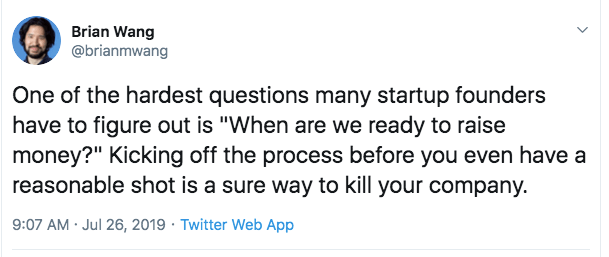
My friend Brian Wang posted an interesting topic on Twitter recently — when should you raise money?

Screen Shot 2019-07-30 at 10.22.31 AM

Like everything else, we hear conflicting advice on when is the best time to start meeting with VCs. Some VCs say that you should start building relationships early. Others say that you should only pitch when you are at the right point in your business. What’s a founder to do?

A few thoughts on this:

1) Founders are not treated equally

I’m just going to go ahead and call out this inequality — there are a lot of VCs who are looking to fund people with a particular background. Such as founders who are based in the Bay Area, who come from product or engineering backgrounds, and did really well at a great tech company like Google or Facebook (or now Uber / Pinterest / AirBnB et al), went to a particular school, and perhaps, is of a certain demographic in terms of gender and race. For these founders, a lot (not all) VCs want to start building relationships early so that when these founders hit upon a great idea, they can swoop in and fund the deal.

If you fall into this category, I would definitely meet with many VCs early and start building relationships and then continuing those relationships with the people you like. “Hey, I’m testing ideas in the area of problem X, and I would love to get to know you and see if this is a general area of interest.” VCs will give you lots of time of day if you fit this profile.

If you do not fall into this category — and most of us do not –unfortunately, VCs will really only give you one shot on goal to get your pitch right, and so timing is everything.

(Note: I’m not saying this inequality is right — it’s definitely not. But, this is the state of affairs and I think it’s important to just address that plainly and openly.)

2) Know which VCs fund which stage

If you are in the latter category, it will be really important to do your research on which VCs are funding which stage (as well as obviously verticals / geography / etc). If you are in the post-seed / mango seed stage, then you should pitch investors who fund this stage. We at Hustle Fund, for example, would not be a good fit. (We do pre-seed.)

Seed is a huge range these days — know where in seed you are and where investors are investing and target your pitch to that stage of investor.

3) Get the timing right

Within each stage, it’s important to get the timing of your pitch right. At a high level, all VCs want to invest in startups that:

  • Have a strong direction
  • Have positive momentum
  • Have a clear set of milestones for funding

It’s important to have all 3 of these components.

A) Strong direction

VCs want to see a strong direction. It shows leadership and a goal. Now, you might be thinking, who doesn’t have a goal? Who doesn’t have a direction? There are lots of reasons a startup may not have a strong direction at a given time. For example, if you are still deciding what to build. Or if you are mid-pivot — i.e. you were working on one thing before but are exploring a new thing, that’s not a good time to raise. It’s ok to be in either of these situations, but these are not good times to be meeting with VCs.

If you pivot, you need to test quickly and have conviction to go all in. This is especially hard, because usually when people pivot they already have some momentum on something else, so it’s hard to want to abandon that past work completely in order to take the chance in going after a better opportunity.

Strong direction also means having a plan. You need to do A, B, and C. This is hard in running a startup, because it’s never really clear what you should do. It’s your job to find that clarity and run with it.

B) Positive momentum

Obviously, you want to have positive momentum as well. So, meeting VCs when you are on upward trajectory — e.g. posted your best traction-month ever. Or received a lot of press recently. Or made some key hires. Or onboarded a marquee customer brand. Or are shipping quickly. All of these things are times of positive momentum and good times to be meeting with investors.

On the flip side, if your revenue is decreasing / flatlined, or your unit economics are getting worse or you are getting bad reviews, these are all bad times to raise.

You also need to be having *significant* momentum. For example if you are surveying customers and then you start designing mockups for a prototype, that would be momentum but not significant.

cookiemonster.gif

Courtesy of Giphy

C) Clear milestones

The founders I speak with often don’t have a clear set of milestones when they raise. I often hear founders say they are raising X for 18 months of runway. Investors aren’t interested in funding runway. They want to know what you will achieve or are hoping to achieve with this amount of money. Obviously you may end up missing the mark — and that’s ok, but at least have a clear plan of what you are going after with this amount of money.

You’ll want to paint a story around, “I am raising X because I will use the money to do A, B, and C.”

Applying this to pre-seed, seed, and post-seed stages

Let’s apply all of this more concretely to the various stages of seed.

The three stages of seed these days is roughly: pre-seed, seed, and post-seed.

A) Pre-seed

For pre-seed, you need to have a clear direction and understanding of the problem you are solving. You need to have built a product at a minimum in many cases and in some cases, done some level of customer validation — ideally with real users or revenue traction.  (If you are in a regulated industry such as health / fintech or are building hardware, this is less applicable but you still need to show that you’ve done something rather than just thought up the idea yesterday)

If you are still surveying people or doing customer discovery, you are probably too early to be meeting with investors. Momentum — you need to be shipping fast and getting new customers or leads each week. You should really feel like the ball is moving fast at this stage. I’ll give you an example of what fast looks like at this stage — I chatted with a startup founder in November of last year. They were working on an idea I didn’t find interesting, but the founders seemed impressive. I was very candid and said that I didn’t have conviction on the problem they were working on but if they ended up pivoting, I wanted to take a look at the new idea. The team ended up pivoting in the next month — going all in on their new idea and built the product quickly, and by end of January, they had gotten 2000+ users already. That is what speed to pivot and momentum looks like — new idea, new product, and thousands of users within 2 months. I invested.

B) Seed

For seed, you definitely need to have direction and momentum already. At this stage, investors are typically looking for 30%+ MoM growth (the numbers are small so sometimes even higher). And at this stage, you are starting to form a growth story. This is still a scrappy stage, but you should be focused on painting a picture around how a business is built around your product. Milestones: Based on whatever unit economics you have, can you paint a picture around how you can put money into certain customer acquisition channels and get customers profitably? I would try to get this answer before you meet with investors — even if it’s on a small scale, you need to show the path to how this becomes a big business assuming the channels continue to work (which they won’t).

C) Post-seed

Definitely, by this point, you should be able to articulate what your current unit economics are and in which channels you acquire users / customers and show how if you take X in investment, you can pour it into those channels and turn it into a $2-$3m net revenue runrate business, which are roughly typical series A metrics for a software company. If you don’t have that level of conviction or knowledge on how to do that, then you need to figure that out before you pitch.

Unit economics also matter a lot on customer acquisition spend — if you are wildly unprofitable, you need to figure out how to get closer to the break even point in acquisition. Maybe you need to upsell more to make your customers more valuable. You don’t need to be profitable, but you need have a clear story to growth and profitability before you meet with VCs.

Caveats

As alluded to above, if you are in a regulated area (fintech / health) OR are in hardware / non-software OR ad-based revenue models, then your milestones will be different. But, at a high level, this is still how I would think about whether you have a good raise story before you meet with investors.

After all, unfortunately, most entrepreneurs only get one shot on goal.

How to think about different types of funding for your early stage startup

One of the things that I’m noticing is that the early stage financing scene is changing quite rapidly. It may not feel like it — it’s still hard to raise money of any form, but there are a lot more options now than say even 5 years ago.

Traditionally, you have a lot of tech startups flocking to venture capital firms to raise money, because VCs have done a great job, as an industry, in marketing themselves. But the vast majority of startups who seek VC funding are not the right profile for that type of funding. As an entrepreneur, this is something I didn’t understand — what types of funders are out there and who is a good fit for what?

For example, angels and VCs are often lumped together in the same category. Afterall, they both invest in early stage startups on an equity-basis (this includes investing in convertible notes and convertible securities as well)  But they could not be more different. (See my post on closing angel investors)

In this post, I want to talk about different categories of funding beyond equity-based financing. These are categories I’d not even thought about as a founder. Here are the rough categories of financing options for early stage founders:

1) Equity financing (priced / notes / convertible securities)
2) Revenue based financing
3) Debt financing

…and some permutation of the above!

giphy

Image credit: Giphy

1) Equity financing

This is the one that everyone knows about or at least has heard about. In its simplest form, with equity financing, you as the founder sell shares in your company for cash.

Variations on this include using convertible notes and convertible securities (SAFEs / KISS doc). (see here for details on the differences)

What most people don’t realize is that this is the most expensive form of financing if you are successful. Why? Because your payback amount is delayed significantly and the amount you end up paying back is a LOT if you are successful.

Let’s say you sell 5% of your company for $100k. You think “whee! I have $100k to work with.” In 10 years, if you do incredibly well, and now your company is worth $100m and you sell your startup for an all-cash deal, you pay your investor $5m (assuming no dilution in this example). That is a 50x return for your investor.

Now let’s suppose you had a crystal ball and you knew this outcome would definitely happen.  Knowing that, would you take this deal? Of course not. $5m is a ridiculous amount to give up for a $100k investment. If you knew for certain that this outcome would happen, you would likely try to fund your business with other money so that you could retain the extra $5m for yourself. Right?

Now of course, the reason entrepreneurs take this deal is that you don’t know ahead of time if you will be successful in 10 years! And most founders don’t get to this outcome. A common phenomenon that I see successful founders face is that they are at first incredibly excited to raise their first couple of rounds of equity but then later, they become a bit frustrated that they have taken too much dilution.

Guess what — equity investors need to take a lot of your company in order to justify the risk they take so early on in your business. The heavy amount of equity you sell in your business needs to offset all the losers in a given investor’s portfolio (plus more).

People don’t realize that equity financing is one of the most expensive forms of financing — because you don’t feel it until years later.

The flip side is if you raise equity financing and your company does go belly up, you don’t owe anyone anything. The investor is taking all the risk here as well.

2) Revenue based financing

Revenue based financing is a bit akin of income-shared agreements (ISAs) for individuals. With revenue based financing models, an investor invests money not for shares in your company but for a repayment percentage until you hit a certain cap.

In this model, say we invest $100k and the deal is to pay 10% of your revenue every week until you hit 1.2x or $120k in total repayments. Let’s say that next week, you generate $10k in revenue, so in this model, you pay back $1000 that week. And the week after that, let’s say it’s a great week, and you generate $20k in revenue, so you pay back $2000 that week. Now let’s say that the following week, you have a bad week, and you make $0. You pay back $0. In this model, the investor is with you through the highs and the lows — always taking 10% no matter what. If it takes you 6 months to hit $120k in repayments, that’s a great fast return for the investor, and if it takes you 3 years to repay back $120k, that’s probably a lot slower than the investor would have liked with a much lower IRR. He/she is with you through the ups and the downs — that is the risk that he/she takes.

Investors in this model make money by essentially picking companies that are generating fairly consistent revenue that have low default risk, and they are trying to target quick payback periods so that their IRR is high.

Now, let’s compare this form of investing vs equity investing. Suppose again we are pretty certain we can sell our company for $100m in 10 years, I would rather take $100k in revenue-based financing. Afterall, I would only have to pay back $120k instead of $5m.

But, let’s say we are at the very very beginning of our startup, and we don’t have many customers and not a lot of revenue. Equity financing allows us to keep all of the cash we make to pour back into the business. We don’t have to pay anyone out each week, and that extra cash can help us get to the $100m outcome faster on an equity investing model. Moreover, we probably wouldn’t qualify for revenue-based financing at that stage.

3) Debt financing

The last form of common early stage financing is debt financing. Unlike revenue-based financing, this is time based. This is also the cheapest form of capital but also the riskiest to the entrepreneur. In debt financing, if an investor puts $100k into your company, he/she is looking to be repaid back with interest by a certain date. So, say we do a debt investment of $100k into a company, we might ask for $120k back after 1 year (the principle plus 20% annual interest).

In addition, often, you have to personally guarantee a loan if your company cannot pay it back. Sometimes, debt financing come with warrants as well — if an entrepreneur cannot pay back the debt within a certain time period, the entrepreneur must give up other things including equity in the business.

So even though this is the cheapest form of financing, it’s also the highest risk for the entrepreneur.

Tying this all together…

Let’s analyze all of these forms of financing. First off, usually debt is the cheapest form of capital and equity is the most expensive. Now you might think, “Wait, a minute! 20% annual interest in this last example feels really expensive!” But when you compare the interest to the revenue based financing model and the equity model, it’s not.

To compare all 3 of these financing options, we need to look at the returns on the same time scale.

  • An equity investment of $100k that turns into $5m 10 years later has an average annual IRR of 48% per year.


  • A revenue-based financing investment of $100k that turns into $120k in 6 months has an average annual IRR of 44% per year.


  • And of course, a debt investment of $100k with 20% interest after 1 year has an average annual IRR of 20% per year.

Of course, if the time scale for the revenue based financing model changes, that will impact the IRR. And if the company that raised money on an equity basis exits earlier or later, that will also change the IRR for the equity-based investment.

Now of course, we are just looking strictly at what capital each scenario can provide. However, it’s possible that with a value-add investor, he/she can change the trajectory of your company. In the equity example, what if it were your $100k investor who introduced you to your would-be acquirer? Then the $5m repayment seems totally worth it. Or what if he/she introduced you to your key hire that led to the acquisition? Totally worth it.

Wrapping this up…

Even though it’s a much cheaper form of financing, founders are typically averse to debt. It’s a natural reaction, because in our personal lives, we go around saying, “Oooooh, debt is bad.” In our personal lives, debt is often bad, because your own cashflows are generally not growing faster than your interest rate. You typically are not getting 20%+ year over year raises each year.

In a startup, if your revenues are growing 20% MoM and your interest rate is only 20% year over year, you are growing your business significantly faster than your debt. And so not only will you have the cash flows to cover this 1.2x multiple of investment, but cash that you can put to use today will make your company worth (1.2^12) 9x more valuable a year from now, while you are only required to pay back 1.2x of the cash you took in.

In the early days when you have no revenue (and maybe you cannot get other forms of financing), equity financing is the least risky for you as the entrepreneur, because not only are you NOT on the hook for losses, but you can pour all revenue back into your business. But once you start to get some certainty around your revenues and some predictability around your cash flows, it may make sense to look at a blend of different forms of financing.

For example, let’s say we’ve started a business, and we are doing $12k per month in revenue and growing on average 20% MoM. What if we did $90k in equity financing and 10% in revenue based financing? If our revenue and cash flows are growing at more than 20% year over year, then this could makes total sense.

On the surface, it may seem insignificant to only raise $10k in revenue based financing, but when you think about what that could potentially become in 10 years,  using the example above, it would be $500k in liquidity in 10 years on a $100m company exit, which is pretty significant.

I think that once you have some level of understanding of your cash flows, it makes sense to look at your composition of financing and try to figure out what proportions of various forms of financing make sense based on your risk tolerance and predictability of your cash flows. I don’t think we do this enough as business owners.

How to close angel investors

Last week I spoke at the LAUNCH Festival Sydney in Australia. Huge thanks to the entire LAUNCH team for bringing me down and for their fantastic event / hospitality; it was an awesome experience and I had a great time!

talk_sydney

Photo courtesy of someone on Twitter – apologies, I didn’t write down who took this — thank you! (Email me and will credit you)

Most of my posts are about raising money from Silicon Valley VCs. But, the world is filled with all kinds of investors. And most businesses are not backable by most Silicon Valley VCs because:

  • They are not software-enabled ideas
  • They are not deemed to be in a large enough market for a VC to invest
  • The founders don’t want to build a “Go big or go home” business
  • Etc…

But these are not bad things. There are going to be plenty of big winners in say e-commerce / direct-to-consumer products that VCs will not back. Or in real estate. Or all kinds of other things. And it isn’t a bad thing if a founder wants to build a business that gets to say $10m per year and sells for $40m. That’s a fantastic outcome for founders. But, most VCs will not back any of these things.

So who do you pitch for money?

The good news is that the world is filled with money. It may not seem like it, but it really is. Your job as an entrepreneur is to find it and unlock it. So, I wanted to share some new material I created for the LAUNCH event on how to find angel and close investors. Here are my slides:

The overall takeaway from these slides is:

  • There are lots of rich people worldwide — they don’t even have to be super rich. There are lots of angels who can write you a $1k-$10k check.
  • Angels may not know they are angels. It’s your job to plant the seed in their heads that you are open to an investment from them!
  • Angels are motivated by many different things; figure out how to tie your story to something that they want; getting an investment – much like sales – is about solving for their needs not yours
  • It’s a numbers game — pitch many many people and don’t give up

Go out and pitch your eye doctor!

Thoughts on our 10 year wedding anniversary

Today is my 10 year wedding anniversary! Happy anniversary to my better half who goes by online alias John Jacob Jingleheimer Schmidt (JJJS)!

wedding

Photo credit: Earl Solis 

Something I’m thinking about today is that I feel so lucky. Namely, I’m glad that someone is willing to deal with me! Being together with an entrepreneur is really really difficult as many of you know. We started dating when I was 23 years old, and like for so many people, at 23, you just don’t quite know where you’re going in life. Years later, my career has taken both of us on a path of so many meanderings, ups and downs, and geographical relocations, and I’m so grateful that JJJS has been through it all with me. A few thoughts and anecdotes to share about all this:

10 years ago

When we got married 10 years ago, I had left my cushy job at Google just months before to become an entrepreneur. I had no idea what I was doing. And, I didn’t know how to make money. At that time, he was starting his post-doc.

On just a post-doc salary, we scrimped and saved like crazy. To make extra money, I did really bizarre side gigs. For example, one of those side gigs was a research study, where some lady from Xerox Parc followed me around for several days. She followed me to the grocery store — and even around in our apartment — literally everywhere and listened in on all conversations and took lots of notes! Other side gigs that I undertook included critiquing resumes for aspiring MBA students in Taiwan and categorizing whiskeys. Looking back, financially speaking, it was an incredibly stressful start, because I was making no money from my startup and the supplemental gigs came in weird ways. (This was before the rise of the gig economy.)

Career sacrifices

Lesser talked about amongst dual income households, in general, are all the sacrifices that are made in order for both people to work — specifically when you have children. When I was 23 with big aspirations, I didn’t think about rearing my future children. Questions like “Who is going to take care of them when I’m traveling?” Or “Who is going to do drop off and pick up?” never crossed my mind. A few years ago, when we had our first child, all of those questions suddenly came up. By complete luck, I picked the right partner, and all of those logistics have worked themselves out, because JJJS has made so many sacrifices to make our household functional. But this is not something that I had thought about at all when we first met.

When I was going through the acquisition process with my startup a few years ago, my baby was just a few months old. As so many of you know, being a parent to a very young child is incredibly draining — babies don’t sleep through the night and they constantly need to feed. So while I was traveling all around the country for meetings about my company, JJJS was holding down the fort at home, slogging through traffic to do all the drop offs and pickups at daycare, not sleeping and being the 24-7 solo parent. At that time, so many people commended me — “Wow, that is badass — YOU are running around doing all these business meetings and pumping in between meetings?  That’s amazing!” But, it’s often the spouse who has to hold down the fort outside of the company who is the unsung hero — for anyone who has ever had young children, wrangling your child is often even more challenging than running a company! (no joke…)

The article that I often refer to and think of that really hits close to home is this one by Andrew Moravcsik where he talks about the necessity of becoming a primary parent once his wife Anne Marie Slaughter’s career became really demanding.

JJJS has made a ton of sacrifices in his own career for mine even though he has big aspirations himself. For example, he left a unicorn synthetic biology startup with great culture and where he was employee #2 to trek across the country so that I could advance my own startup. He is the rock in our family who has taken on much more stable jobs throughout the years to pay the bills, while I’ve largely gone about taking on a lot of risk in building my startup(s) and now nascent VC practice. I know that so much of my own career is only possible because of all his support and sacrifices.

So here we are — 10 years in. Although I could not have predicted what life would look like when we got married, I’m incredibly grateful to JJJS for this journey we’ve been on. I love you, JJJS!

How do VCs make money?

I’ve written a little bit before about how venture capitalists (VCs) make money (see this post).

But I’ve never quite spelled it out, and in this post I’ll do just that. I think it’s useful to understand this — certainly for anyone who is an aspiring future VC — but even for entrepreneurs, because it helps to understand the mindset of people you’re pitching.  

What is a Venture Capitalist (VC)?

At a high level, the concept of a VC is relatively straightforward — a VC is basically a middle (wo)man.  On one side, a VC will raise money from rich people called Limited Partners (LPs). These can be individuals, families, corporations, and other funds who invest in funds, etc. VCs then take that money and on the other side, invest in startups. The hope is that some subset of those startups will grow tremendously, and then through some sort of liquidity event — it could be an acquisition or an IPO or even a way to sell shares to someone else in a secondary sale, the VC will receive back a lot more cash than initially invested.  That cash then gets returned back to the initial investors and the VC makes some money in between. 

Typical VC structure

A very common lifespan of a VC fund in the US is 10 years.  In other countries, this varies quite a bit — in China, for example, VC funds have been set up to be closer to a 5 year time horizon.  

The term is largely based on how long it will take to get liquidity on deals. Investors who invest in such a fund are committed to locking up their capital for 10 years. Now throughout the 10 years, it’s possible that investors may receive capital back from exits that happened before 10 years, but the bulk of the great exits will happen closer to the 10 year mark. For reference, Dropbox went IPO after 15 years, and so if you were an early stage investor, you would’ve made a lot of money, but that may not have happened for many years.

Side note: it is possible with the new Long Term Stock Exchange (LTSE) coming to fruition, we may see early stage VCs shorten their time horizons to getting liquidity.  The bar to have a successful IPO on the NYSE and the NASDAQ has been raised considerably since the 90s, so companies have been staying private for much longer. If you look back at Amazon’s IPO in the 1990s, their valuation was pegged just over $400m. These days, Uber went public at over $80B valuation!  If we enable more liquidity events at earlier stages, it’s possible we may see changes in fund lifespans.

In the US, a typical VC firm economics structure follows a 2% / 20% rule.  The 2% rate represents management fees. And the 20% represents something called carry.

What are management fees?

Management fees are basically the operating budget for a VC firm on an annual basis.  So in a 2% model, if you have a $10M fund, you have a $200,000 budget every year for the course of your fund.

If you have a $100m fund, with a 2% structure, you’d have an annual operating budget of $2 million each year. So as you can see, there is a stark difference in budget between a microfund and a large Sand Hill VC. And when people talk about VCs having nice salaries, they are referring to partners and employees who work at the latter type of firm — firms with a lot of money under management. Microfunds are very much like bootstrapped startups.

Let’s dive into the economics of a $10m fund. The $200,000 budget needs to cover just about everything.  Certainly, it includes salaries, but it also needs to include other things like marketing expenses, health insurance and travel. If you have an office, that must fit under this budget too. And so if your typical microfund has two partners, they are definitely earning well under $100,000 per year, and more likely closer to $50,000 given that all expenses must fit under this $200,000 number.  For us at Hustle Fund, in our 3 person partnership, we have publicly stated that we currently each make close to $50k per year and feel lucky to be able to bootstrap for a while.

What is carry?

The 20% represents the profit sharing of a VC fund. The way profits are distributed look something like this:

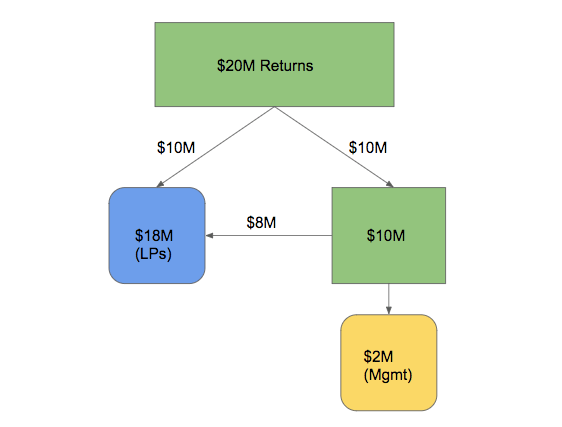
Say a $10m fund returns $20m. The initial $10m is first returned to the Limited Partners (LPs).  Then the $10m profit is returned such that the fund managers receive 20% of this profit, or $2M (the yellow shape) in this example.  That $2m is then distributed to the employees / partners of the fund based on however they’ve all mutually agreed to do so. (At Hustle Fund, all 3 partners have equal carry).   And, the LPs receive the rest – $8M in this example, and so the LPs receive a total of $18m in this example (the blue shape).

Even though the fund returned 2x at a gross level, after all is distributed, LPs see a net multiple of 1.8x, because of the carry.  

Screen Shot 2019-06-06 at 3.08.36 PM.png

The power law of startups

Ok, now let’s look at the investing side. The interesting thing about the investing side is that startup outcomes are distributed very much in line with the power law. Namely, most startups will fail and will go to zero — i.e. you will lose your money entirely.  Some will maybe return 2x or more. And if you have an excellent portfolio, you will capture a 100x-1000x returning company once in a while.

In order to succeed at investing in startups, you absolutely need at least one of these outliers in order to be successful. I hear all these non-investors or new investors talk about trying to find 3x multiples in startups. If you are investing at the early stages, you need to be aiming for much higher than that…  

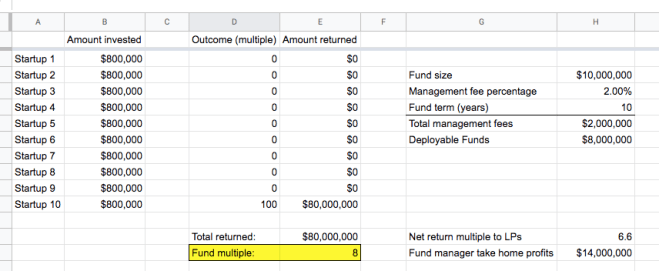
I put together this spreadsheet of startup outcomes that everyone can copy, so you can all play with the numbers.

Screen Shot 2019-06-07 at 2.16.15 PM.png

Let’s look at the tab labeled “1 – 100x return”. If we assume the trite saying that 9/10 startups fail, and let’s say we have one big winner that delivers 100x returns, you can see that we can return an overall nice fund — 8x gross multiple, 6.6x net multiple to LPs.  From this, you can see that it doesn’t matter that we have really low survivability in the portfolio. All that matters is that your one big winner was quite big.

Dilution impacts your returns as an early stage investor

Now, let’s add the impact of dilution back into this equation.  Typically, a cap table will get diluted down by 10-30% each round, with an average being around 20%.  Assuming that we are the earliest stage investors, this means that if a founder does 3 rounds of funding after ours, we will be diluted down by about 50%!  So I modeled out the 100x winner as 50x in the next tab. You can see we are still returning good returns but if you aren’t aiming for 100x gross difference between your entry point and exit point in your investments, things start to get a bit dicey.  

Can you improve survivability?

There’s a lot of debate amongst VCs about whether the 9/10 survivability that everyone touts is actually accurate. Can you help your companies survive longer so that you have more winners?  

giphy

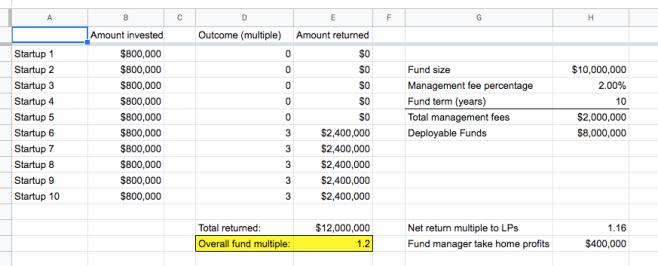
I personally think the answer is yes, but I think you still need at least one big winner to make the portfolio work out well. If we look at the tab labeled “5 – 3x returns”.  You can see that even if we do phenomenally well with picking startups who have high survivability, if they are not returning much, our multiple on our fund is just barely over 1x and the net to LPs is basically that they get their money back.  Wait, what is going on? There are a lot of 3x returners!

Screen Shot 2019-06-07 at 2.17.21 PM.png

The primary reason for this is the management fees.  Even though this VC fund isn’t making money off management fees — heck their budget is only $200k per year, on a $10m fund, $2m in total is used for management fees. In other words, this money isn’t being invested.  So only $8m is invested, and so you have to overcome this initial hurdle to get to 1x. A lesser reason is once you cross the 1x hurdle, carry digs into some of the profits. (Side note: most VCs recycle small exits in order to invest more than 80% of their fund, but getting money back to recycle is not guaranteed and for the purpose of simplification, I removed that scenario.)

To be clear, this isn’t a situation that the managers of the fund want either.  They are taking a puny salary of like $50k per year. And their profits are only $400k after 10 years of work that gets divided across the partnership — this is really dinky.

So you can play with the numbers on this spreadsheet, but you’ll find that even if you can increase survivability, you still need to be aiming for big winners.  

How do you get a big winner?

Now, what does it mean to get a 100x returner? This means that if we invest at say $3m post money valuation, and the company sells for $300m, the difference in entry point and exit point is 100x. (Accounting for 3 rounds of dilution, this will be closer to a 50x returner).  

Think about it — $300m is a big exit. It’s more than life-changing for most entrepreneurs. And many entrepreneurs might be tempted to sell even sooner.  Heck $30m for most people is life changing. Remember, as a VC, we are the middle (wo)man, so we need that exit to be large for us to make a lot of money. But the entrepreneur doesn’t need a large exit to make good money. So there’s a bit of a disconnect there.  

Large multiples occur when there’s a large spread between entry point valuation and exit valuation. VCs all have different strategies to achieve this. Some like to go in at low valuations and then sell for sub billion dollar exits.  And this works, because there are many more exits that are sub $1B. And then there are VCs who have the exact opposite strategy. Entry point doesn’t matter, but they are gunning for an exit at a multi-billion dollar valuation. For example, Uber’s IPO was approximately at $80B valuation. If you got in at $5m valuation, then that’s on the order of a 10,000x multiple after accounting for dilution. So with that kind of exit, who cares if you got in at the $5m valuation or the $10m valuation or even higher — it’s all a wash at that scale.

But regardless of the strategy, all VCs aim to have large multiples.

You can also see that VCs can do VERY well if they end up getting a few 100x winners.  Play with the spreadsheet — even with just one more 100x winner on the first spreadsheet, you can see that the net fund outcome to LPs goes up to 13x. So, a $100k investment into a fund turns into a million dollar outcome.  On the flip side, more 3x outcomes on the last spreadsheet with near perfect survivability in a portfolio isn’t that awesome.

Takeaways

Based on all of this, this explains why VCs:

  • May be valuation sensitive (depending on the strategy)
  • Are only looking for super large outcomes and don’t care about good businesses
  • Often pattern match — if they believe that “certain types of founders” can get funding easily, then they may have an easier time growing super large companies (I don’t believe in this personally, but this explains this behavior)
  • Are looking for fast growth — winners must get to a billion dollar level within just a few years since a VC fund term is 10 years
  • Fight over pro-rata — dilution can be rough so maintaining ownership in companies that are clearly strong winners is helpful to returns
  • Don’t care about massive failures and would much prefer even just 1 “go big or go home” outcome to one that will be successful at a $50m outcome level.

I think following the money is always a good way to understand why people behave the way that they do. Hopefully these spreadsheets help to understand how VCs make their money. 

To SAFE or Not to SAFE?

VCs debate quite a bit about whether they like The YC SAFE or not. (Spoiler: Most do not…) We’ve done a lot of investments on SAFEs as well as on notes and in equity rounds, so I thought I’d outline pretty openly the pros and the cons of raising money on a SAFE.

First off, what is a SAFE?  

A SAFE is a convertible security that was developed and evangelized by YCombinator.  (500 Startups also has a convertible security called the KISS).  The convertible security concept, in itself, is an interesting innovation.  In essence, the convertible security is a placeholder for equity without the cost of both time and money doing an equity deal.  For a more detailed primer on convertible securities and the differences between those and convertible notes and equity, read my post here. (A lot of people, especially investors, confuse convertible notes and convertible securities but they are actually quite different! One is debt and the other is a placeholder for equity)

PROs for using a SAFE:

  • Your legal costs will be zero or low because it’s a template
  • There is no minimum threshold to raise before a deal goes through; investors simply sign and wire
  • Investors receive equity when an equity round happens; if a company goes through a liquidity event before an equity conversion happens, you’ll convert to equity and receive your proportional share
  • The new SAFE is a post-money SAFE, which is a BIG deal

The last bullet deserves a conversation in itself.

The post-money SAFE is easier math to calculate than the old pre-money SAFE

Previously, there was a lot of confusion before about how much equity an investor really owned.  The old SAFE was a pre-money SAFE — meaning your equity ownership was affected by how much money was raised on other SAFEs.  When companies raised lots of money at different caps on the pre-money SAFE, the math got to be pretty confusing for many people — both founders and investors.  No one really understood how much equity they owned. I also saw a lot of math mistakes in various deals that we were in that converted these SAFEs to equity. Investors were upset because they thought they owned a certain percentage of a company but then actually didn’t.  Founders didn’t understand how much of their company they had company they had sold.  This is why there are so many articles about how SAFEs are not SAFE.  The biggest pushback against the SAFE is in response to the old pre-money SAFE not the new post-money SAFE — namely, that no one knows how much equity they own.

With the new post-money SAFE, it’s quite easy for everyone to figure out how much equity has been sold.

giphy

Photo credit: Giphy

How to compute your ownership with the new post-money SAFE

Let’s say that we invest $30k on a post-money SAFE with a $3m.  We own $30k (how much we invested) / $3m (the post-money valuation) = 1% of the company.  That’s it.  When we convert this SAFE in the first equity round, we will own 1% of the company.  It doesn’t matter who else is investing and at what price or anything.

This is a lot easier for people — both investors and founders — to understand.

Now let’s say the company raises another tranche of money on a post-money SAFE with $5m cap.  Let’s say we put in $50k now.  We own with this tranche: $50k / $5m = 1% of the company.

Now when both of these SAFEs convert, they will convert at the same time.  So we now own 1% + 1% = 2% of the company upon conversion.

One update and caveat (6/7/2019): Thank you to Seth Bannon of Fifty.vc — “The new post-money SAFEs get diluted by any options pool created for the equity round (the old SAFEs did not) so an investor’s actual ownership will likely be ~10% less than this example.”

Continuing on with the other PROs…

SAFEs enable small investments

For smaller investors (such as ourselves), there’s a cost to doing a deal (mostly legal).  So, with a SAFE, this makes our costs virtually nothing.  This means that with a SAFE, as a founder, you can bring in small investment checks here and there a lot more easily, and you don’t even need a lead.

The reality is that most companies will not be able to raise a seed round with an institutional lead, but there are many more startups that will go on to do incredibly well and should be able to be backed.  I like that SAFEs democratize the startup ecosystem and make funding more accessible beyond the 100 or so seed funds that write large checks. 

What are the CONs?

These are the biggest CONs that I hear about the SAFE:

  • People don’t know how much of a company they own (addressed above)
  • Investors modify the SAFE
  • QSBS tax exemption doesn’t apply to SAFEs
  • SAFE holders don’t receive dividends

Another pushback that I often hear about the SAFE is that a lot of investors try to modify it to create weird new SAFEs.  I encourage investors to please please please not do that.  Templatizing docs, in general, is a good thing — it reduces time and legal fees to do a deal, and if you want modifications, please use a side letter.  The SAFE is meant to remain a lawyer-free template.  Templates keep the expenses down for smaller investors who cannot afford high legal fees.  Reviewing a side letter is a lot easier / faster / cheaper than reviewing a modified SAFE.

From our experience, the biggest downside as a very early investor is that QSBS tax exemption doesn’t apply to SAFEs. This is a much longer blog post, but the QSBS tax exemption was enacted in the US to encourage early stage investment.  If you hold private company stock for more than 5 years and there are other criteria met by that startup, any gains from a sale of that stock after the 5 years is tax exempt. This is amazing!  However, if you are a SAFE holder for 2 years and then you convert to equity and then the company sells 4 years later, you do not reap those benefits even though you made the investment 6 years ago.

One last corner case of being a SAFE holder is that even though you will convert to equity, if a company doesn’t raise more money nor has a liquidity event and then starts printing money and issuing dividends to shareholders, you as a SAFE holder do not get those dividends. This is a possible situation (though rare) – have never come across it myself personally.

SAFEs avoid dilution

There’s one last interesting tidbit about SAFEs – I couldn’t decide whether this is a pro or a con. I’m seeing money raised on SAFEs at the pre-seed, seed, and post-seed levels.  Let’s go back to that prior example where we invested in a company twice at two different caps on a SAFE.

Now let’s say that we invested those same amounts on two separate equity rounds at the exact same prices.  The interesting thing is that when we invest in two separate equity rounds, our first check got diluted down…  But when we invested both checks on SAFEs, we did not get diluted down, because both SAFEs converted simultaneously into the first equity round.

As we see multiple tranches of seed happen more and more, investors who write checks on a SAFE will avoid some dilution than if they were to invest in the equivalent equity rounds.

And for founders, this characteristic of the post-money SAFE is a double-edged sword.  On one hand, the post-money SAFE is great because it’s easier to figure out how much of the company a founder has sold.  On the other hand, ultimately, its founders who take more dilution on this new SAFE than on the equivalent equity rounds.  However, I think if everyone is aware of how this conversion happens, then this characteristic should just get priced into the initial cap of the SAFE.

Final thoughts

All-in-all, on the net, we, as a small fund, like the SAFE, because being able to do small deals as a small fund or an angel enables more startups to get funded. I can understand why larger funds would prefer to do large equity rounds – the reality is that often it’s the smaller investors who bubble up those deals before the large funds end up funding some of them.  And empowering smaller investors is a good thing for the ecosystem, because more startups can then have a shot at the big stage.

Featured photo courtesy of Pexels