Finding purpose and mission in bleak times

This past week was particularly exhausting. I think I speak for almost everyone when I say this.

And the prior two weeks were rough as well.

It’s hard to find comfort in times where people all around the world are getting very ill (COVID-19) and in some cases, dying a slow horrific death. Our medical professionals on the front lines have no equipment. Everything is basically shut down – wall street is falling and main street is crumbling. Panicked people are hoarding. The news is infuriating. And being cooped up inside with small children all day is not easy. For the better part of the last few weeks, I’ve felt helpless about everything going on around me.

It’s during times like these that it’s important to dig deep. A question I’ve often asked myself over the past few years is “Why do you do what you do?” And this is the question I ask of you today.

And, if the world were to end tomorrow, what do you wish you would’ve done differently? What do you want to be remembered for?

For many years, I didn’t know the answer to any of these questions. But in the last few years, it really clicked.

One thing that I noticed in the past few years is that the best entrepreneurs are very often overlooked in the beginning, and it’s hard for them to get access to resources. Certainly, well-connected people who went to certain schools or worked at certain places may often be an exception, but in large part, this is true (and even for many well-networked people). I believe that people who are “great hustlers” – as defined as people who execute with speed – ought to be able to get access to resources even in the very beginning their journeys.

And so, two years ago, armed with this mission, I started Hustle Fund with two friends of mine: Eric Bahn and Shiyan Koh. We have a long ways to go, and right now, we can only chip at the problem little by little and are not able to help every great hustler today. But we’re working on this mission over the next 30 years or so.

Your mission may be different.

Img courtesy: motivationaltwist.com

I am fortunate that my mission carries over professionally as well as personally. I am paid (a little bit) to follow my mission. But, your work doesn’t have to align with your mission – that’s ok. For many people, a job pays the bills to allow you to follow your personal mission outside of work. But always remember your mission even if it’s not your livelihood.

In times like these, it’s especially important to remember what your mission is so that you can dig deep and find the courage to do the hard things that these times may require of you.

For many of my entrepreneurs whom I’ve backed, as well as broader main street, these tines are going to really test their leadership. Most of them will have to lay off a lot of people in order for them to keep going to fulfil their missions. Many of them will see significant drops in their revenues as consumers are not able to spend as much money — or at all — at home. Many of them will feel like they have spent the last 2 years working so hard a building traction only to start anew — an incredibly frustrating experience. The decisions we will see our entrepreneurs make over the next few weeks or months will not be easy.

Lack of morale makes it hard to get out of bed in the morning. But it is during these times, you actually have to do the exact opposite of what you naturally want to do in order to succeed. You must find courage to embrace these tough challenges and inspire others to help you achieve your mission. And this is where mission comes in — when everything else around you is falling apart, other people are no longer motivated by money or traction or achievements — because all of these things are gone or have dropped considerably or are unstable. People are motivated by what the future looks like and the mission you want to achieve not the past.

In some cases, missions are really easy to convey. For health companies, for example, they can say their mission is to “find the cure to cancer or whatnot”. But for most companies, missions are a bit less clear. My former startup was an advertising technology company. I can tell you that most people don’t find it inspiring to work at an ads company. “To show as many ads as possible” would just not be a mission that many people would sign up for. (nor would I) And yet, there are often great missions behind companies without obvious missions. Zappos is a great example of a company that conveys their mission well. They want to provide the best customer service and just happen to sell shoes. Google is actually an ads company (which so many people don’t think about including Googlers themselves), but they want to organize the world’s information to make it accessible to all.

Remembering your mission helps you focus. It’s also makes it easier to make tough decisions – such as layoffs. If you remember your mission and why you’re doing what you’re doing in the first place, it’s often clear what the path needs to look like even if it’s a tough one to go down. The right sacrifices in the short term are often beneficial in the long term.

In addition, if your mission is really clear, many people will want to rally behind it. I was talking with a fellow fund manager the other day, and I was beaming about my amazing team. He was a bit confused how I even found all these kickass people (let alone pay for them). I told him that most people on our team could be making way more money elsewhere, and as a small microfund, we have no budget. But it’s the mission that everyone rallies around. Building a microfund is in fact not the best or easiest way to make money — there are much better and easier ways to do so. But at Hustle Fund, we are constantly selling as many people as we can on our mission — whether they are potential team members, investors, startups, or partners. People who join forces with us want to change the world and invest in the best hustlers even if they didn’t go to MIT or live in the middle of nowhere. Mission can often compensate for many things — even if you have near zero cash or resources.

Missions extend beyond companies. In fact, companies often start out as personal missions that rally up other people who also believe in the same cause. If you don’t already have a mission, that’s ok! This is a good time to come up with one or join someone else’s.

People often hesitate in thinking through their personal missions, because we’re all so busy. Almost too busy to think. And too busy to do or too busy to help. But one of the things that I’ve learned over the years is that there is no amount of help, thought, money, time, etc that is too small. In fact, what I’ve learned is that the secret to the success of the Silicon Valley is lots of bits of small help here and there. There are so many angel investors here who run around town investing $1k into startups here and there. $1k as a startup investment sounds incredibly small, but these all add up. Small bits of capital combined with new connections to larger checks and more resources — this is how you get momentum going. On our own Fund 1 for Hustle Fund, we had some investors write us $10k or $25k checks in the beginning — that doesn’t get you very far in raising $10m, but it does get you a lot of credibility and momentum. And I am so grateful to those small check writers who supported us on Day 1 and believed early and helped us get others rallied around our cause. Generalizing this, in a crisis, if you want to set out to help small businesses, even buying a $5 gift card is helpful. That sparks momentum. AND, if can you leverage your social capital on social media to turn $5 into friends putting in $100 and they in turn promote this which turns into $1000, that’s valuable. A $5 donation quickly gets leveraged to $1000s. I have seen this happen time and again. Small actions go a long way.

Going back to my mission, my mission doesn’t just apply to Hustle Fund. In my personal life, I ask myself what resources can I help procure (either my own or rally others around)? And who are the effective stewards (hustlers) of those resources to have the biggest impact? Although at Hustle Fund, we currently only apply this mission to venture backable startups, on a personal front, I think about all the other groups where this thinking can apply.

To that end, here is a running Google Doc of the activities I think are worth promoting – activities that I’m personally getting involved with on some basic level. I won’t ever be effective on the front lines – I have zero medical knowledge. I know nothing about main street. But I can help as a connector. Connecting resources to hustlers is what I do. That is what I want to be remembered for.

I challenge all of you to think through your personal mission. Dig deep. Then roll up your sleeves to start to build or rebuild towards it. In these challenging times, we will need all hands on deck in a whole variety of ways — in health, in business (your own or others), etc. No amount of thought, time, money / other resources, or help is too small.

Let’s go make some dreams come true.

The rise of the global first startup

In the past 5 years, there have been a lot of changes in the startup ecosystem. One of the big changes is in geographical activity. 

At Hustle Fund, we invest in early stage startups that are in the United States, Canada, and Southeast Asia. We do this all with one fund. And often we get asked, why don’t we start regional funds?  To be honest, this is something that we had thought about very deeply. But what we are seeing in the startup ecosystem today is that startups are global from day one. And that the concept of a “regional fund” doesn’t make much sense anymore or at least is too nebulous.

5 years ago, if you were building a startup, you would be crazy to try to be “global first” startup. If you were building your team in other countries or even other cities, that seemed like a bad idea. If you were trying to sell a product to customers elsewhere, that also seemed like a bad idea. Specifically, the reason why this seemed like a bad idea is that it seemed like the logistical challenges in coordinating with other people would just be so cumbersome that it would negatively affect your business. These days, I would argue that you’re at a disadvantage if you are not a “global first” startup.

giphy-1

Photo credit: Giphy

Most 2019 unicorns are in the United States and China.  And, these companies were largely started in the United States and China and grew up in these places. I believe that we will continue to see this trend. But, if you look at say the the up-and-coming San Francisco based companies that will become unicorns in the next couple of years, many of them were not started in San Francisco.  Many of them were started elsewhere OR have significant offices elsewhere. If you dig into this list of up-and-coming unicorns, not only do you see a number of companies that are based elsewhere, but you see companies like Front or HackerOne labeled as San Francisco companies though they started got their foothold elsewhere. 

This matters, because how startups get their foot on the first rung of the ladder is what enables them to get going. If you can reduce your costs on engineering talent and manage teams well from the beginning, you can take your company a lot further for the same amount of money.  I recently caught up with two past portfolio companies, and I was floored that both of them were doing $5m ARR with fast growth and had raised very little seed funding. If you were to look at their cap tables, one had sold less than 10% of their cap table on a fully diluted basis and the other had sold less than 10% of their business fully diluted. Their next raise will probably be mega series B or C equivalent rounds and will have experienced much less dilution than your typical fast growth startup that starts and grows up in San Francisco. I asked them, “How were you able to build and sell so much with so little?” That’s when I learned that both companies had engineering teams elsewhere. Their engineering teams were in Vietnam and Argentina respectively. Both teams had a technical co-founder leading product outside of the United States. And both teams had customer acquisition teams based in the United States – sales, marketing, and business development.

When I look at my Hustle Fund portfolio, which is newer, I also see the same trend. Even if not hiring abroad, my companies are hiring outside of San Francisco. One of my current portfolio companies who has actually raised a lot of cash and is based in the San Francisco area has more employees in Dallas than here. You would not know that by just looking at the company as an outsider.  To most people, they seem like a regular, ordinary San Francisco-based company. I have other portfolio companies that are also on a fast-growth trajectory who from day 1 started building teams elsewhere as well. One of my fast-growing B2B companies has more employees based in Nepal than here in the San Francisco Bay area, and they are a SF-based company. We have portfolio companies who have engineering and operations teams in places like Bulgaria, Canada, and Nigeria. By hiring talent and managing talent outside of San Francisco, companies can see a 3-5x difference in cost than hiring in San Francisco.  Roughly speaking, this means that you can extend your runway 3-5x longer which is huge when you are trying to find product-market fit or make a big enterprise sale that won’t happen for 2 years. 

I think five years ago, there was this notion that technical talent in San Francisco was stronger than elsewhere. I think that is only true when you’re talking about the top 1%. It’s not because San Francisco naturally breeds smarter people, but it’s because you have companies like Google and Facebook who are willing to pay $1m+ per year to attract that global talent to the Bay Area in the first place. But, can startups woo that 1% talent away from Google and Facebook? And my hypothesis is that only in rare cases can this happen.  Startups can’t compete with the GOOG on comp or benefits. And, I’m seeing most of this talent either starting their own companies or working for a friend’s very promising company. 

And so most SF Bay Area startups are not able to hire this talent — they are hiring good talent for sure. But you can hire good talent elsewhere too for lower salaries.  I think sometimes we think that the more you are paid, the better you are, but that is actually not true. How much you are paid is largely related to the cost of living of where you are. In parallel, what we are also seeing are two other trends.  1) Knowledge is becoming more and more of a commodity. You can find all kinds of free information on the internet on how to do just about anything. 2) We are also seeing a lot of tools coming up to make development easier or in some cases, allow you to build things with no code.  If you are building a “deeptech” startup, then you do need to hire the best technical talent in many cases, but most say typical B2B startups that are coming up don’t need particularly deep technical knowledge. So, you can get the same level of talent quality for a fraction of the cost in places where the cost of living is cheaper.  

Now, hiring people in multiple locations certainly has a ton of challenges. It is challenging to build rapport with people remotely. And it is challenging just to get people to work together remotely. I think all of these challenges still apply even now but are a bit easier than 5 years ago.

Over 5 years ago, remote communications was a challenge.  Nothing really worked well. I remember Skype and Google Hangouts being just sh*tty.  (They still are) I hired remotely for my startup, and I was one of the early users of Zoom for my startup LaunchBit. Prior to that, we had tried just about every video conferencing software possible, and nothing worked well.  But, with Zoom, we gave everyone an iPad and had everyone just leave Zoom on all day everyday. The calls *never* dropped. And there was never any latency. It was like we all sat in the same room. Today, we also have Slack, which has made communication so much easier.  And a lot of wiki-like tools.  

What I have seen work the best with regard to tight communications, is to build a hub-and-spoke model. For most of my portfolio companies, they have distinct offices in specific places. They build out teams in these places, and there is a team leader of sorts in each place.  Usually a co-founder who had spent time in the US and met the US-based co-founder and then returned home to build the team. And it is the team leaders who need to coordinate the best remotely. E.g. it is the technical co-founder who coordinates really well with the business co-founder to test hypotheses together to get to product-market fit. And they have really quick feedback loops. So then you’re not really talking so much about coordination of many people, but you are talking about the coordination of a couple of people.

Building culture, though, is the tricky part. How do you ensure that each team has the same culture? And that’s hard. I don’t have a great answer for this. even when I worked at a large company – Google – I noticed that the culture was different in the Boston office than at headquarters in Mountain View. This isn’t a bad thing, but it is challenging to have to ensure that all teams have the same culture.

Beyond working with teammates globally, we also have portfolio companies who are doing some crazy global arbitrage things. For example, in Canada, the government offers startups so many grants of all kinds. And that reduces the costs dramatically or reduces the need to take dilutive funding. In contrast, in the US, most software startups do not qualify for any grants.  One of my San Francisco-based teams actually set up a Canadian entity just to take advantage of one of these grants. 5 years ago this might have seemed like a weird distraction. But today, this type of arbitrage can buy you a couple of extra years of runway or reduce your need for dilutive capital.  

On the business side, we have US portfolio companies who are now selling to potential clients in Asia. and we have Southeast Asian companies who are selling globally or to the US market. Five years ago, this seemed impossible but today, this makes a lot of sense for the right business. 

How can you sell abroad? I see most of my portfolio companies or past portfolio companies building out their customer acquisition team in the market they are selling to. But even in the beginning when it’s just the co-founders, this is possible too.  Even many years ago, when I was selling ads for my startup, my customers were in India and Israel and Europe . And, I made all of those sales over the phone or over video conference. In fact, those sales were done in the same way that I sold to US customers. The only difference is that sometimes I would have to stay up and make those sales or get up early in the morning.  In fact, some of my current portfolio companies are finding that it is actually easier to sell to customers in another geographical market. Customers in another region of the world may be hungry for technology in a way that local customers may not — especially when you’re building to disrupt old stodgy industries. Sometimes finding product-market fit is tied to to geography.

So when I look at our portfolio, I cannot quite “bucket” so many of my companies. I have companies that are San Francisco-based but have operations or development in another country or another city.  In other cases, we have Singaporean companies that sell to the US. What it means to be say a “San Francisco-based company” is quite nebulous these days.  

In fact, when I previously was running an accelerator in a past life, in one of my batches, I had a portfolio company with a co-founder who was from another country X and had a development team in country X.  But the company was incorporated in the US and both co-founders lived in the SF Bay Area. My past employer also had a regional fund that invested in companies in country X. And, the fund manager for country X was a bit ticked off at me at first for not showing him that deal.  

I was puzzled, “But they are a US company and the co-founders live here — I thought you are investing in startups in country X.” I said. 

“But the founder is from country X and they have a team in country X,” he said. 

That was the first time I started thinking about this issue. My mind raced through all of our companies in the accelerator batch and past batches. It dawned on me that most of the companies in our accelerator were US companies (SF based) who had teams elsewhere and that geography had become blurred.  That was a few years ago, and now it’s even more blurred. 

In this modern economy, if you can navigate hiring and building teams in different locations and selling to customers in other areas, you are at a serious advantage. And in many cases, I think in the next 5 to 10 years, I think this will become not only a nice to have skill set but a necessary skill set. 

What questions will early stage VCs ask you?

I thought it might be helpful to create a live running Google Doc of all the major questions that a VC might ask you.

Go to -> Questions that a VC might ask you.

If there are more questions you think I should add to this list, please comment in the Google Doc, and I’ll add additional ones that get multiple votes.

I’ve highlighted in blue the questions that I care the most about. I’ll certainly ask questions about traction just to get an understanding of what has been done in the company, but as a pre-seed investor, we do most of our investments pre-traction. This will, of course, be different for a seed or mango-seed investor.

What is most interesting to me in looking at all the questions I’ve highlighted in blue is that you can see I very much gravitate towards customer acquisition questions.  It isn’t so much that I care about what your LTV and CAC are today.  In fact, in most cases, your CAC will only go up (significantly) and your LTV will hopefully be worth more in the future, so it doesn’t mean anything to me! But I want to understand how you think about getting customers.

customerservice.gif

Credit: Giphy

Most entrepreneurs at the pre-seed stage haven’t thought much about customer acquisition. In my view, this is what separates savvy or experienced entrepreneurs from everyone else.

The savviest or most experienced entrepreneurs will often think through the customer acquisition first before even thinking about the product.

At this stage, no one will have all the answers, but a great entrepreneur will think through things like “is this problem important enough that customers will part with their money for this?” and “what is my wedge into this market to beat out alternatives / competitors?”  The savviest or most experienced entrepreneurs will start pre-selling ahead of having a product and know that these results are more telling than surveys.  These are the kinds of things that I want to understand at the pre-seed stage.

What questions do you think should be added to this list?

When is the right time to approach a VC?

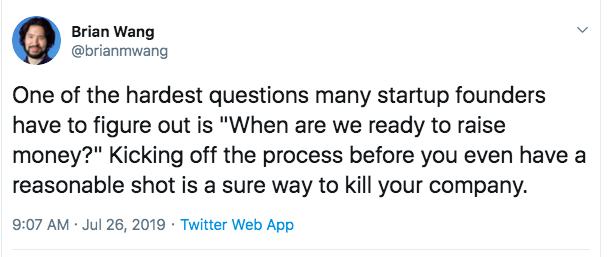
My friend Brian Wang posted an interesting topic on Twitter recently — when should you raise money?

Screen Shot 2019-07-30 at 10.22.31 AM

Like everything else, we hear conflicting advice on when is the best time to start meeting with VCs. Some VCs say that you should start building relationships early. Others say that you should only pitch when you are at the right point in your business. What’s a founder to do?

A few thoughts on this:

1) Founders are not treated equally

I’m just going to go ahead and call out this inequality — there are a lot of VCs who are looking to fund people with a particular background. Such as founders who are based in the Bay Area, who come from product or engineering backgrounds, and did really well at a great tech company like Google or Facebook (or now Uber / Pinterest / AirBnB et al), went to a particular school, and perhaps, is of a certain demographic in terms of gender and race. For these founders, a lot (not all) VCs want to start building relationships early so that when these founders hit upon a great idea, they can swoop in and fund the deal.

If you fall into this category, I would definitely meet with many VCs early and start building relationships and then continuing those relationships with the people you like. “Hey, I’m testing ideas in the area of problem X, and I would love to get to know you and see if this is a general area of interest.” VCs will give you lots of time of day if you fit this profile.

If you do not fall into this category — and most of us do not –unfortunately, VCs will really only give you one shot on goal to get your pitch right, and so timing is everything.

(Note: I’m not saying this inequality is right — it’s definitely not. But, this is the state of affairs and I think it’s important to just address that plainly and openly.)

2) Know which VCs fund which stage

If you are in the latter category, it will be really important to do your research on which VCs are funding which stage (as well as obviously verticals / geography / etc). If you are in the post-seed / mango seed stage, then you should pitch investors who fund this stage. We at Hustle Fund, for example, would not be a good fit. (We do pre-seed.)

Seed is a huge range these days — know where in seed you are and where investors are investing and target your pitch to that stage of investor.

3) Get the timing right

Within each stage, it’s important to get the timing of your pitch right. At a high level, all VCs want to invest in startups that:

  • Have a strong direction
  • Have positive momentum
  • Have a clear set of milestones for funding

It’s important to have all 3 of these components.

A) Strong direction

VCs want to see a strong direction. It shows leadership and a goal. Now, you might be thinking, who doesn’t have a goal? Who doesn’t have a direction? There are lots of reasons a startup may not have a strong direction at a given time. For example, if you are still deciding what to build. Or if you are mid-pivot — i.e. you were working on one thing before but are exploring a new thing, that’s not a good time to raise. It’s ok to be in either of these situations, but these are not good times to be meeting with VCs.

If you pivot, you need to test quickly and have conviction to go all in. This is especially hard, because usually when people pivot they already have some momentum on something else, so it’s hard to want to abandon that past work completely in order to take the chance in going after a better opportunity.

Strong direction also means having a plan. You need to do A, B, and C. This is hard in running a startup, because it’s never really clear what you should do. It’s your job to find that clarity and run with it.

B) Positive momentum

Obviously, you want to have positive momentum as well. So, meeting VCs when you are on upward trajectory — e.g. posted your best traction-month ever. Or received a lot of press recently. Or made some key hires. Or onboarded a marquee customer brand. Or are shipping quickly. All of these things are times of positive momentum and good times to be meeting with investors.

On the flip side, if your revenue is decreasing / flatlined, or your unit economics are getting worse or you are getting bad reviews, these are all bad times to raise.

You also need to be having *significant* momentum. For example if you are surveying customers and then you start designing mockups for a prototype, that would be momentum but not significant.

cookiemonster.gif

Courtesy of Giphy

C) Clear milestones

The founders I speak with often don’t have a clear set of milestones when they raise. I often hear founders say they are raising X for 18 months of runway. Investors aren’t interested in funding runway. They want to know what you will achieve or are hoping to achieve with this amount of money. Obviously you may end up missing the mark — and that’s ok, but at least have a clear plan of what you are going after with this amount of money.

You’ll want to paint a story around, “I am raising X because I will use the money to do A, B, and C.”

Applying this to pre-seed, seed, and post-seed stages

Let’s apply all of this more concretely to the various stages of seed.

The three stages of seed these days is roughly: pre-seed, seed, and post-seed.

A) Pre-seed

For pre-seed, you need to have a clear direction and understanding of the problem you are solving. You need to have built a product at a minimum in many cases and in some cases, done some level of customer validation — ideally with real users or revenue traction.  (If you are in a regulated industry such as health / fintech or are building hardware, this is less applicable but you still need to show that you’ve done something rather than just thought up the idea yesterday)

If you are still surveying people or doing customer discovery, you are probably too early to be meeting with investors. Momentum — you need to be shipping fast and getting new customers or leads each week. You should really feel like the ball is moving fast at this stage. I’ll give you an example of what fast looks like at this stage — I chatted with a startup founder in November of last year. They were working on an idea I didn’t find interesting, but the founders seemed impressive. I was very candid and said that I didn’t have conviction on the problem they were working on but if they ended up pivoting, I wanted to take a look at the new idea. The team ended up pivoting in the next month — going all in on their new idea and built the product quickly, and by end of January, they had gotten 2000+ users already. That is what speed to pivot and momentum looks like — new idea, new product, and thousands of users within 2 months. I invested.

B) Seed

For seed, you definitely need to have direction and momentum already. At this stage, investors are typically looking for 30%+ MoM growth (the numbers are small so sometimes even higher). And at this stage, you are starting to form a growth story. This is still a scrappy stage, but you should be focused on painting a picture around how a business is built around your product. Milestones: Based on whatever unit economics you have, can you paint a picture around how you can put money into certain customer acquisition channels and get customers profitably? I would try to get this answer before you meet with investors — even if it’s on a small scale, you need to show the path to how this becomes a big business assuming the channels continue to work (which they won’t).

C) Post-seed

Definitely, by this point, you should be able to articulate what your current unit economics are and in which channels you acquire users / customers and show how if you take X in investment, you can pour it into those channels and turn it into a $2-$3m net revenue runrate business, which are roughly typical series A metrics for a software company. If you don’t have that level of conviction or knowledge on how to do that, then you need to figure that out before you pitch.

Unit economics also matter a lot on customer acquisition spend — if you are wildly unprofitable, you need to figure out how to get closer to the break even point in acquisition. Maybe you need to upsell more to make your customers more valuable. You don’t need to be profitable, but you need have a clear story to growth and profitability before you meet with VCs.

Caveats

As alluded to above, if you are in a regulated area (fintech / health) OR are in hardware / non-software OR ad-based revenue models, then your milestones will be different. But, at a high level, this is still how I would think about whether you have a good raise story before you meet with investors.

After all, unfortunately, most entrepreneurs only get one shot on goal.

How to close angel investors

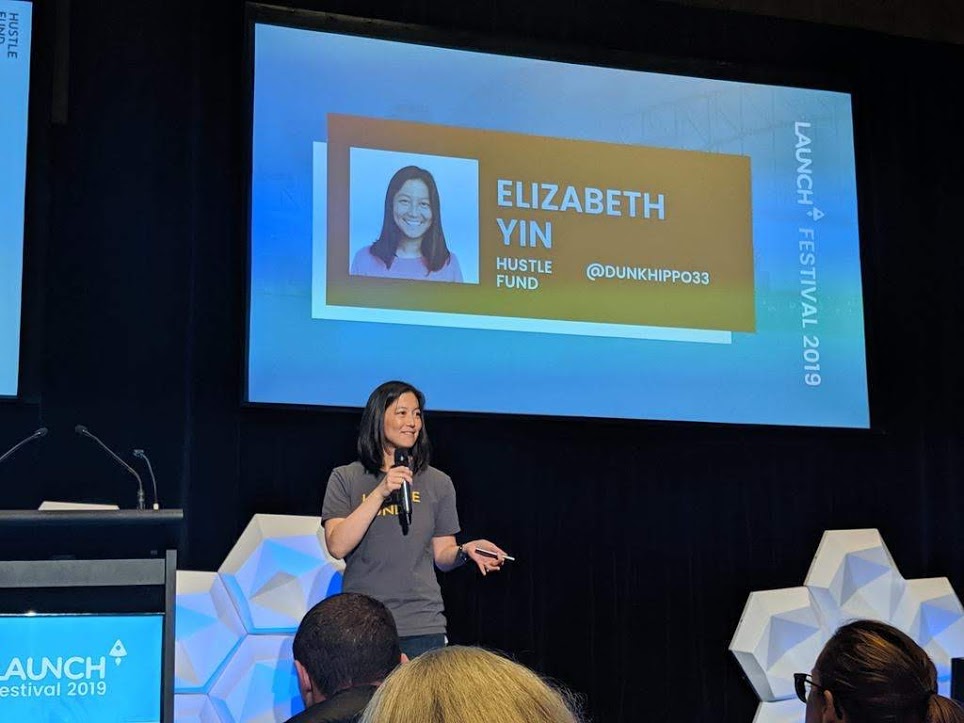
Last week I spoke at the LAUNCH Festival Sydney in Australia. Huge thanks to the entire LAUNCH team for bringing me down and for their fantastic event / hospitality; it was an awesome experience and I had a great time!

talk_sydney

Photo courtesy of someone on Twitter – apologies, I didn’t write down who took this — thank you! (Email me and will credit you)

Most of my posts are about raising money from Silicon Valley VCs. But, the world is filled with all kinds of investors. And most businesses are not backable by most Silicon Valley VCs because:

  • They are not software-enabled ideas
  • They are not deemed to be in a large enough market for a VC to invest
  • The founders don’t want to build a “Go big or go home” business
  • Etc…

But these are not bad things. There are going to be plenty of big winners in say e-commerce / direct-to-consumer products that VCs will not back. Or in real estate. Or all kinds of other things. And it isn’t a bad thing if a founder wants to build a business that gets to say $10m per year and sells for $40m. That’s a fantastic outcome for founders. But, most VCs will not back any of these things.

So who do you pitch for money?

The good news is that the world is filled with money. It may not seem like it, but it really is. Your job as an entrepreneur is to find it and unlock it. So, I wanted to share some new material I created for the LAUNCH event on how to find angel and close investors. Here are my slides:

The overall takeaway from these slides is:

  • There are lots of rich people worldwide — they don’t even have to be super rich. There are lots of angels who can write you a $1k-$10k check.
  • Angels may not know they are angels. It’s your job to plant the seed in their heads that you are open to an investment from them!
  • Angels are motivated by many different things; figure out how to tie your story to something that they want; getting an investment – much like sales – is about solving for their needs not yours
  • It’s a numbers game — pitch many many people and don’t give up

Go out and pitch your eye doctor!

Thoughts on our 10 year wedding anniversary

Today is my 10 year wedding anniversary! Happy anniversary to my better half who goes by online alias John Jacob Jingleheimer Schmidt (JJJS)!

wedding

Photo credit: Earl Solis 

Something I’m thinking about today is that I feel so lucky. Namely, I’m glad that someone is willing to deal with me! Being together with an entrepreneur is really really difficult as many of you know. We started dating when I was 23 years old, and like for so many people, at 23, you just don’t quite know where you’re going in life. Years later, my career has taken both of us on a path of so many meanderings, ups and downs, and geographical relocations, and I’m so grateful that JJJS has been through it all with me. A few thoughts and anecdotes to share about all this:

10 years ago

When we got married 10 years ago, I had left my cushy job at Google just months before to become an entrepreneur. I had no idea what I was doing. And, I didn’t know how to make money. At that time, he was starting his post-doc.

On just a post-doc salary, we scrimped and saved like crazy. To make extra money, I did really bizarre side gigs. For example, one of those side gigs was a research study, where some lady from Xerox Parc followed me around for several days. She followed me to the grocery store — and even around in our apartment — literally everywhere and listened in on all conversations and took lots of notes! Other side gigs that I undertook included critiquing resumes for aspiring MBA students in Taiwan and categorizing whiskeys. Looking back, financially speaking, it was an incredibly stressful start, because I was making no money from my startup and the supplemental gigs came in weird ways. (This was before the rise of the gig economy.)

Career sacrifices

Lesser talked about amongst dual income households, in general, are all the sacrifices that are made in order for both people to work — specifically when you have children. When I was 23 with big aspirations, I didn’t think about rearing my future children. Questions like “Who is going to take care of them when I’m traveling?” Or “Who is going to do drop off and pick up?” never crossed my mind. A few years ago, when we had our first child, all of those questions suddenly came up. By complete luck, I picked the right partner, and all of those logistics have worked themselves out, because JJJS has made so many sacrifices to make our household functional. But this is not something that I had thought about at all when we first met.

When I was going through the acquisition process with my startup a few years ago, my baby was just a few months old. As so many of you know, being a parent to a very young child is incredibly draining — babies don’t sleep through the night and they constantly need to feed. So while I was traveling all around the country for meetings about my company, JJJS was holding down the fort at home, slogging through traffic to do all the drop offs and pickups at daycare, not sleeping and being the 24-7 solo parent. At that time, so many people commended me — “Wow, that is badass — YOU are running around doing all these business meetings and pumping in between meetings?  That’s amazing!” But, it’s often the spouse who has to hold down the fort outside of the company who is the unsung hero — for anyone who has ever had young children, wrangling your child is often even more challenging than running a company! (no joke…)

The article that I often refer to and think of that really hits close to home is this one by Andrew Moravcsik where he talks about the necessity of becoming a primary parent once his wife Anne Marie Slaughter’s career became really demanding.

JJJS has made a ton of sacrifices in his own career for mine even though he has big aspirations himself. For example, he left a unicorn synthetic biology startup with great culture and where he was employee #2 to trek across the country so that I could advance my own startup. He is the rock in our family who has taken on much more stable jobs throughout the years to pay the bills, while I’ve largely gone about taking on a lot of risk in building my startup(s) and now nascent VC practice. I know that so much of my own career is only possible because of all his support and sacrifices.

So here we are — 10 years in. Although I could not have predicted what life would look like when we got married, I’m incredibly grateful to JJJS for this journey we’ve been on. I love you, JJJS!

How do VCs make money?

I’ve written a little bit before about how venture capitalists (VCs) make money (see this post).

But I’ve never quite spelled it out, and in this post I’ll do just that. I think it’s useful to understand this — certainly for anyone who is an aspiring future VC — but even for entrepreneurs, because it helps to understand the mindset of people you’re pitching.  

What is a Venture Capitalist (VC)?

At a high level, the concept of a VC is relatively straightforward — a VC is basically a middle (wo)man.  On one side, a VC will raise money from rich people called Limited Partners (LPs). These can be individuals, families, corporations, and other funds who invest in funds, etc. VCs then take that money and on the other side, invest in startups. The hope is that some subset of those startups will grow tremendously, and then through some sort of liquidity event — it could be an acquisition or an IPO or even a way to sell shares to someone else in a secondary sale, the VC will receive back a lot more cash than initially invested.  That cash then gets returned back to the initial investors and the VC makes some money in between. 

Typical VC structure

A very common lifespan of a VC fund in the US is 10 years.  In other countries, this varies quite a bit — in China, for example, VC funds have been set up to be closer to a 5 year time horizon.  

The term is largely based on how long it will take to get liquidity on deals. Investors who invest in such a fund are committed to locking up their capital for 10 years. Now throughout the 10 years, it’s possible that investors may receive capital back from exits that happened before 10 years, but the bulk of the great exits will happen closer to the 10 year mark. For reference, Dropbox went IPO after 15 years, and so if you were an early stage investor, you would’ve made a lot of money, but that may not have happened for many years.

Side note: it is possible with the new Long Term Stock Exchange (LTSE) coming to fruition, we may see early stage VCs shorten their time horizons to getting liquidity.  The bar to have a successful IPO on the NYSE and the NASDAQ has been raised considerably since the 90s, so companies have been staying private for much longer. If you look back at Amazon’s IPO in the 1990s, their valuation was pegged just over $400m. These days, Uber went public at over $80B valuation!  If we enable more liquidity events at earlier stages, it’s possible we may see changes in fund lifespans.

In the US, a typical VC firm economics structure follows a 2% / 20% rule.  The 2% rate represents management fees. And the 20% represents something called carry.

What are management fees?

Management fees are basically the operating budget for a VC firm on an annual basis.  So in a 2% model, if you have a $10M fund, you have a $200,000 budget every year for the course of your fund.

If you have a $100m fund, with a 2% structure, you’d have an annual operating budget of $2 million each year. So as you can see, there is a stark difference in budget between a microfund and a large Sand Hill VC. And when people talk about VCs having nice salaries, they are referring to partners and employees who work at the latter type of firm — firms with a lot of money under management. Microfunds are very much like bootstrapped startups.

Let’s dive into the economics of a $10m fund. The $200,000 budget needs to cover just about everything.  Certainly, it includes salaries, but it also needs to include other things like marketing expenses, health insurance and travel. If you have an office, that must fit under this budget too. And so if your typical microfund has two partners, they are definitely earning well under $100,000 per year, and more likely closer to $50,000 given that all expenses must fit under this $200,000 number.  For us at Hustle Fund, in our 3 person partnership, we have publicly stated that we currently each make close to $50k per year and feel lucky to be able to bootstrap for a while.

What is carry?

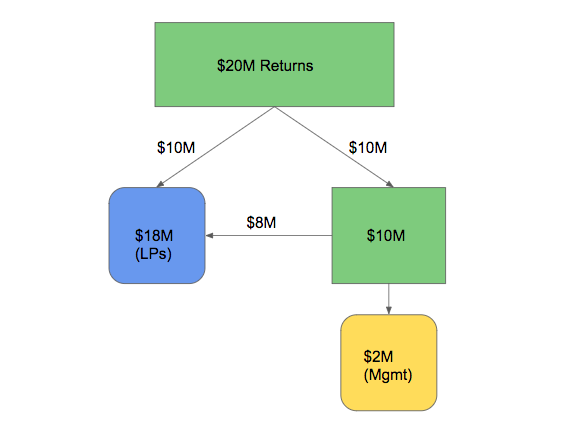
The 20% represents the profit sharing of a VC fund. The way profits are distributed look something like this:

Say a $10m fund returns $20m. The initial $10m is first returned to the Limited Partners (LPs).  Then the $10m profit is returned such that the fund managers receive 20% of this profit, or $2M (the yellow shape) in this example.  That $2m is then distributed to the employees / partners of the fund based on however they’ve all mutually agreed to do so. (At Hustle Fund, all 3 partners have equal carry).   And, the LPs receive the rest – $8M in this example, and so the LPs receive a total of $18m in this example (the blue shape).

Even though the fund returned 2x at a gross level, after all is distributed, LPs see a net multiple of 1.8x, because of the carry.  

Screen Shot 2019-06-06 at 3.08.36 PM.png

The power law of startups

Ok, now let’s look at the investing side. The interesting thing about the investing side is that startup outcomes are distributed very much in line with the power law. Namely, most startups will fail and will go to zero — i.e. you will lose your money entirely.  Some will maybe return 2x or more. And if you have an excellent portfolio, you will capture a 100x-1000x returning company once in a while.

In order to succeed at investing in startups, you absolutely need at least one of these outliers in order to be successful. I hear all these non-investors or new investors talk about trying to find 3x multiples in startups. If you are investing at the early stages, you need to be aiming for much higher than that…  

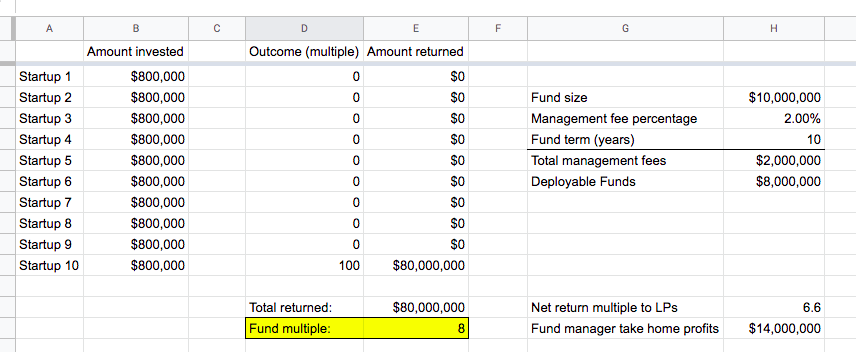
I put together this spreadsheet of startup outcomes that everyone can copy, so you can all play with the numbers.

Screen Shot 2019-06-07 at 2.16.15 PM.png

Let’s look at the tab labeled “1 – 100x return”. If we assume the trite saying that 9/10 startups fail, and let’s say we have one big winner that delivers 100x returns, you can see that we can return an overall nice fund — 8x gross multiple, 6.6x net multiple to LPs.  From this, you can see that it doesn’t matter that we have really low survivability in the portfolio. All that matters is that your one big winner was quite big.

Dilution impacts your returns as an early stage investor

Now, let’s add the impact of dilution back into this equation.  Typically, a cap table will get diluted down by 10-30% each round, with an average being around 20%.  Assuming that we are the earliest stage investors, this means that if a founder does 3 rounds of funding after ours, we will be diluted down by about 50%!  So I modeled out the 100x winner as 50x in the next tab. You can see we are still returning good returns but if you aren’t aiming for 100x gross difference between your entry point and exit point in your investments, things start to get a bit dicey.  

Can you improve survivability?

There’s a lot of debate amongst VCs about whether the 9/10 survivability that everyone touts is actually accurate. Can you help your companies survive longer so that you have more winners?  

giphy

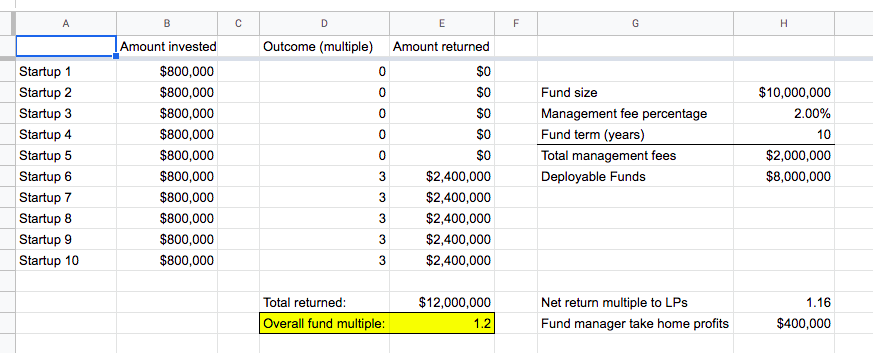
I personally think the answer is yes, but I think you still need at least one big winner to make the portfolio work out well. If we look at the tab labeled “5 – 3x returns”.  You can see that even if we do phenomenally well with picking startups who have high survivability, if they are not returning much, our multiple on our fund is just barely over 1x and the net to LPs is basically that they get their money back.  Wait, what is going on? There are a lot of 3x returners!

Screen Shot 2019-06-07 at 2.17.21 PM.png

The primary reason for this is the management fees.  Even though this VC fund isn’t making money off management fees — heck their budget is only $200k per year, on a $10m fund, $2m in total is used for management fees. In other words, this money isn’t being invested.  So only $8m is invested, and so you have to overcome this initial hurdle to get to 1x. A lesser reason is once you cross the 1x hurdle, carry digs into some of the profits. (Side note: most VCs recycle small exits in order to invest more than 80% of their fund, but getting money back to recycle is not guaranteed and for the purpose of simplification, I removed that scenario.)

To be clear, this isn’t a situation that the managers of the fund want either.  They are taking a puny salary of like $50k per year. And their profits are only $400k after 10 years of work that gets divided across the partnership — this is really dinky.

So you can play with the numbers on this spreadsheet, but you’ll find that even if you can increase survivability, you still need to be aiming for big winners.  

How do you get a big winner?

Now, what does it mean to get a 100x returner? This means that if we invest at say $3m post money valuation, and the company sells for $300m, the difference in entry point and exit point is 100x. (Accounting for 3 rounds of dilution, this will be closer to a 50x returner).  

Think about it — $300m is a big exit. It’s more than life-changing for most entrepreneurs. And many entrepreneurs might be tempted to sell even sooner.  Heck $30m for most people is life changing. Remember, as a VC, we are the middle (wo)man, so we need that exit to be large for us to make a lot of money. But the entrepreneur doesn’t need a large exit to make good money. So there’s a bit of a disconnect there.  

Large multiples occur when there’s a large spread between entry point valuation and exit valuation. VCs all have different strategies to achieve this. Some like to go in at low valuations and then sell for sub billion dollar exits.  And this works, because there are many more exits that are sub $1B. And then there are VCs who have the exact opposite strategy. Entry point doesn’t matter, but they are gunning for an exit at a multi-billion dollar valuation. For example, Uber’s IPO was approximately at $80B valuation. If you got in at $5m valuation, then that’s on the order of a 10,000x multiple after accounting for dilution. So with that kind of exit, who cares if you got in at the $5m valuation or the $10m valuation or even higher — it’s all a wash at that scale.

But regardless of the strategy, all VCs aim to have large multiples.

You can also see that VCs can do VERY well if they end up getting a few 100x winners.  Play with the spreadsheet — even with just one more 100x winner on the first spreadsheet, you can see that the net fund outcome to LPs goes up to 13x. So, a $100k investment into a fund turns into a million dollar outcome.  On the flip side, more 3x outcomes on the last spreadsheet with near perfect survivability in a portfolio isn’t that awesome.

Takeaways

Based on all of this, this explains why VCs:

  • May be valuation sensitive (depending on the strategy)
  • Are only looking for super large outcomes and don’t care about good businesses
  • Often pattern match — if they believe that “certain types of founders” can get funding easily, then they may have an easier time growing super large companies (I don’t believe in this personally, but this explains this behavior)
  • Are looking for fast growth — winners must get to a billion dollar level within just a few years since a VC fund term is 10 years
  • Fight over pro-rata — dilution can be rough so maintaining ownership in companies that are clearly strong winners is helpful to returns
  • Don’t care about massive failures and would much prefer even just 1 “go big or go home” outcome to one that will be successful at a $50m outcome level.

I think following the money is always a good way to understand why people behave the way that they do. Hopefully these spreadsheets help to understand how VCs make their money. 

15 Annoying Things that VCs say or ask (and how to think about them)

Today’s blog post is all about the annoying things that VCs commonly say or ask.  I did a call out on Twitter this week and these are the VCisms that the crowds have bubbled up as the most annoying things out of a VC’s mouth.

1) What if Google Builds It?  (@pravesh)

This one was cited a LOT by many people on Twitter in various forms! There were variations — e.g. substitute Google with Amazon or Facebook or any other big company.

Admittedly it’s a valid question — what if the 800 lb gorilla in your space does copy you? What is your edge? How will you win?

Here are a couple of answers that may help:

A. Large companies are so large, they aren’t able to prioritize or even care about your “small” opportunity relative to their huge company. In the case of Google specifically, it has actually been shown that building a Google product competitor can actually be a great opportunity.  Many people would much prefer to pay for products so that they can get customer support when something goes wrong — a free Google product will never a customer’s calls or emails.

Companies like Mixpanel, Optimizely, Superhuman, and many more have built big businesses by going head-to-head with a free Google product by charging customers and providing a better experience.

So it’s actually validation of your market if Google is interested in your space.

B. Big companies, by definition, are no longer nimble.  You, in contrast, are able to run circles around them.  Can you prove that you’re nimble by shipping quickly?  Can you show that customers love you more than Google?  These are concrete things that you can point to in your conversations with VCs.

2) We don’t invest in hardware (only to find out that they led a round for hardware) (@peterjcolbert)

This is an interesting one, because you see VCs deviate from their thesis sometimes.  (Every VC does it – we’ve done it too.).  VCs will often say they don’t invest in hardware.  Or ad revenue based models.  Or e-commerce.  Or in some geography.  And then you see a portfolio company on their website that is clearly in one of these categories.

You should just ask a VC about it directly.  

The reason for this is usually along one of these lines:

A. They used to invest in that category but are now over-indexed. Or they invested in that category previously as an angel or with a past fund. I.e. they used to make those investments but no longer do.

This is important to understand, because if the reason the firm is passing is that they are waiting for some liquidity on existing positions in your space, there could potentially still be an opening for an investment later.  This is rare, BUT possible – this has happened once to a company that I’ve backed before.

B. They are experimenting outside their thesis. E.g. They may not usually invest in South America, but they may make 1 investment to learn about the market. They may not invest in hardware, but may invest in 2 companies to learn about the space.

Unfortunately, if this is the case, you can try to hard to convince a VC to do more experimentation in that category, but because VCs have mandates — i.e. they have an agreement with their investors that they would focus on investing in certain categories / theses, they will likely not want to deviate *too* much from their thesis.  VCs are judged by their investors on whether they end up investing based on the strategy that they claimed they would.

C. They had a special relationship with the founder.

There is nothing you can do about this.  People back their friends all the time regardless of what they are building.

I think it’s easy to walk away fuming mad thinking that a firm is filled with hypocrites, but it’s worth just bringing up with a VC: “Hey you mentioned that you don’t do hardware, but I noticed on your website that you’ve invested in X.  Am curious how that fits your thesis?” You may not like the response and it may not change anything, but on rare occasion it may open a door for you.

3) I don’t think this can be a venture scale business. (@kirbywinfield)

I’m of two minds on this one.

A. There are a lot of companies who seek out venture funding who are actually NOT a good fit for VC investors.  Entrepreneurs should be aware of the return profile that VCs are looking for.  Loosely speaking, VCs are looking for a minimum of 100x return in the course of 5 years or so.  This comes out to achieving roughly $100m runrate within the next 5 years.  Is this what you want to do?

B. However, on the flip side, what ideas will be able to achieve $100m runrate in 5 years is tough to say. VCs often have preconceived notions above what can get to this level and what cannot — and they are often wrong. Companies that tend to get overlooked are in categories such as e-commerce, for example.  Are you selling a widget that will likely max out at $5m in sales per year?  Or are you the next Stitch Fix?

My advice here would be to first understand for yourself if you want to be growing a business that goes to $100m in annual revenue in 5 years (and the work / hiring that will be required to do so). And if so, what do you think that path looks like if everything goes well?  How will you get to $2m runrate this year and then more than double your sales each year thereafter?

And if the answer is that you don’t want to run this type of business, there are other avenues of funding.  Angel funding, crowdfunding, revenue-based financing are all good channels that are now rapidly growing.

4) But how will you manage being a mom AND running a startup? (@hustlefundvc)

Ugh.  Are we in the 21st century?  Move on from any VC who asks this.  It’s not worth it.

5) We’d be interested when we see a bit more traction. (@msuster

Ah, the classic ask for more traction.  Basically, the VC doesn’t have conviction right now, but maybe, just maybe, more traction would give him/her the conviction to do your deal.  The reality is that most investors can’t articulate what level of traction they would want to see in order to invest.  Obviously, if you earn $100m in the next 2 months, everyone will be onboard, but what if you get to $100k / mo runrate in the next year — is that interesting?  Well…it depends.  And unless you are an asshole or a fraudster, VCs always want to preserve optionality to see you in a year and check on your business.

So, although this is a frustrating response, the right way to play this is to triage investors quickly.  Put this VC in a “not interested” bucket. Continue to send him/your monthly investor updates, but you’re better off trying to find someone who has conviction today than trying to convince someone to get conviction — even with traction.  You just need to meet a lot of investors and triage a lot of investors quickly in order to find the right investors to bring into your company.

6) Maybe you should raise more and grow quicker. (@justinpushas)

This is just a stupid comment.  If a VC really believes in your business, he/she will commit to your round, and will either help you fill your larger round or write a bigger check.  But, investors who say things like this without any action are either just oblivious or not helpful, and should just move on from these investors. As we all know, founders who struggle to raise $250k are also going to have a tough time raising $2.5m.

That being said, I would recommend that every founder develop multiple fundraising plans.  This will allow you to pitch a different amount of money to bigger or smaller investors with different milestones and goals that you would achieve with different investment sizes. And then if you do receive this question, you can point to a larger fundraising plan and mention that you have thought about a larger plan and are open to raising more money but are also not limited in growth if you cannot raise that amount now.

7) Come back when you have a lead (@stefanopep3)

The herd of sheep comment!  A variation on this is, “I’m committed once you have a lead.” This is a positive way for a VC to say no for now, but if you have enough fundraising traction, then he/she wants to get his/her foot in the door.

It’s important to clarify what a VC means by this, though.  Does this mean he/she is interested: 

  • When you have most of your round committed?
  • Once terms have been set?
  • If another investor is taking a board seat and is providing “serious responsibility ” for the investment.  (i.e. no party rounds)?

This is important to clarify, because VCs mean different things when they ask about a lead VC. 

If it’s the former — come back when most of the round is committed — you can build your round in many different ways.  You can bring together a party round of smaller investors without a lead on a convertible note or SAFE.  It’s actually quite common these days for a smaller fund to set terms on a note or a SAFE and bring together a round that way.  

And if a VC is just looking to evaluate terms, then you can create your own terms on a note or a SAFE and present those to the VC. 

And lastly, if the VC is looking for a true “lead VC” to invest the majority of the round and take a board seat, etc, then this is a completely different ask from the prior two.

8) Let me know how I can help!  Founder asks for help. *crickets* (@quan)

When I started my VC career, I asked this question to a few entrepreneurs I met with.  I genuinely wanted to be helpful.  Then I quickly realized that there was literally nothing I could help with.  Hah.  Every founder just wanted investment dollars, and if I weren’t investing, I couldn’t even do introductions to other investors, because it would be a bad signal.

9) Nothing. They ghost you. (@ameetshah)

*crickets*

10) Contact us if you like but we prefer warm introductions. (@cwlucas)

I find this ironic — VCs prefer warm introductions, and YET, there are a lot of VC analysts who send outbound emails to startups completely cold asking to chat!

My recommendation here is to try to get a warm referral to a VC.  Just in general, it’s always better to have a common connection to build rapport with.  That being said, a lot of the newer VCs (esp microVCs) are ok with cold emails.  (For reference, 20% of our deals come in completely cold, and we see no difference in performance between the cohort of companies that came in cold vs warm)

My prediction in the next 5 years is that the VC world will move to largely accepting *good* cold emails.  Most cold emails are terrible and will likely be ignored, but you do have a shot if you can send a strong cold email.

11) (Live product, thousands of users) “Yes but what *traction* do you have?” 

(Gets in to YC) “Your valuation is so HIGH now!” (@kristentyrrell)

This is the typical Goldilocks and the 3 Bears problem.  At first, you’re “too early” — you don’t have enough traction.  And then, once you get there or another investor participates in your round and drives the valuation up, then you become “too late” — the valuation is too high.

As frustrating as this is, this is just a matter of luck / timing and fit.  As pre-seed investors, I am susceptible to this as well in some sense.  We invest really early (from a valuation perspective), so, by definition, we are not looking for traction.  This means that we make our decisions entirely based on gut instinct of the opportunity.  So, if we don’t have conviction in the business idea, we will pass. And once a founder proves with traction that we were wrong, we still won’t be able to invest, because the valuation will be too high.  That’s frustrating but I’d say frustrating for VCs who miss out too — as you may have seen from the Uber IPO, lots of VCs lost out on a lot of money, because they didn’t have conviction in the idea.

There’s a lot of gut instinct in this business, and to be honest, to be great at it, you only need to be right about 20-30% of the time.  It’s like baseball – you strike out most of the time.  If you were to work at any other job — imagine if you were say a surgeon — if you were right only 20-30% of the time, you would be fired and everyone would be dead.

Now, this doesn’t apply to multi-stage investors. If they miss out on your seed round, you can still re-approach them at the series A or the series B.

12) Why hasn’t this been done before? (@jacobshiach)

This is a seemingly ridiculous question, and it may also seem that a lazy VC may not want to do his/her own homework.  But, this question is meant to test how you think through trends and changes in your ecosystem.  If you believe that markets are efficient, your opportunity should not exist.  Why?  Because if it’s an obvious opportunity, it means that everyone would have done it already.

So what is your key insight or secret that enables you to know about this opportunity that others do not.  Is it your domain knowledge?  Is it that the opportunity is in between two sectors that most people are not familiar with?  Is it a behavioral trend that is happening to a certain demographic that you are a part of but most entrepreneurs are not?  Whatever it is, every startup needs to have a good answer for this.  Heck, even funds get asked this question — why aren’t other funds doing your strategy?  And I’d say, as annoying as it is, it’s a legit question.

13) How can this be a billion dollar company? (@rkorny)

You might wonder why VCs are so obsessed with billion dollar businesses.  This is because the economics of running a fund are so tough.  Basically, you have a bunch of portfolio companies that will completely fail.  So whatever 1-2 winners you have, will need to make up for that failure plus much more to return multiples for the fund.  (Read more here: https://elizabethyin839669270.wordpress.com/2016/05/15/whats-the-difference-between-angels-and-seed-vcs/)

This means that VCs are looking for 100x+ multiple at a minimum on a successful company, and if they are coming into your round at the seed stage — say at $10m post money valuation, 100x on that is roughly a $1b exit not accounting for dilution.  So this comes back to the question from above — do you want to be raising money from VCs?  Is this the type of business you want to be running?

14) What’s the moat? (for a seed stage company) (@chloealpert)

This is super annoying for a seed stage company, because obviously there is no moat.

Thinking longer term, however, simplistically, there’s only one way to have a moat — and that is, your customers love you so much, they will never want to leave you and keep coming back.  There could be a lot of ways to build this — e.g. you have a better user experience / product, you have more data to make your solution better / more accurate, you have greater network effects and therefore have a better product, etc.  Depending on your idea, the way that you achieve this outcome will differ a lot.

VCs want to understand at scale, how you will achieve this.  This is especially key for companies that have commodity products — such as finance.  You don’t want to be competing on price or better deals, etc.  How will you build that better / smarter product?  How will you build that retention in business model?  VCs want to understand how you think about this 5 years from now more than what things look like today.

15) We’re going to pass but will be cheering for you from the sidelines. (@comaddox)

This is just a ridiculous phrase and pet peeve of mine.  What is this?  Bring It On?

giphy-5


Some thoughts on building wealth

Last week I gave a talk about wealth to students, and I thought that it would be worthwhile to share this here on my blog.

I’ve learned a lot about building wealth over the past 20 years (though am not wealthy yet!).  But, most of my learnings on wealth have come from observation of the people around me in just the last 5 years or so.

First off, I know that many people don’t care too much about money.  And that’s fine!  Many people have very noble missions in life.  But — wealth gives you power — the power to change things. To have influence. To put towards good causes. Whatever you want.

I’ve met so many people over the years who have said to me, “I don’t care about becoming rich – wealth doesn’t motivate me. What motivates me is ABC cause”.  And that may be true, but you need wealth to drive the things that do motivate you to really have an impact.

So, let’s talk about the general strategy to becoming wealthy. I think there are three stages:

  1. Saving money
  2. Investing in low-risk / low-return assets
  3. Investing in high-risk / high-return assets

Let’s dive into each of these stages.

Saving money

The first stage, I think, is obvious to many people.  When you don’t have any or much money, the best way to get started in building wealth is to save money. Some people are good at this. Other people are not good at this.  And people have different strategies on how to save money.  For example, my mom came to this country with just $25.  She and my grandparents were incredibly thrifty people.  One thing that both of my grandparents did was to have all their teeth extracted when they moved to America in order to reduce their dental expenses!  Other people have other strategies for amassing cash savings.  Some people get the highest paying job that they can. Other people don’t eat avocado toast. I think we all have different methods but in general, I think everyone understands that saving money is important in the very beginning.  

Investing in low-risk / low-return assets

The next stage of building wealth is about taking whatever savings you have and putting it into low-risk and low-returning assets. Because after all, you can’t really afford to lose your newly earned cash because you don’t have a lot of cushion.

Surprisingly, we don’t really learn anything in school about investing, which is an utter shame. Most people end up learning a little bit about investing from what they read online or places like Money magazine. Super low-risk and low-returning assets include things like government bonds, savings accounts, and even CDs.  For the most part, you won’t lose your money in these assets, but you won’t make any money either.   

A medium-risk / medium-return asset class that a lot of people know about are index funds — these are baskets of shares of public stocks.  Historically, index funds have returned about 2x over the course of a decade. In other words, if you put in $100 into the S&P 500, 10 years later, you might have about $200.  There is a lot of variation, however, in the returns depending on the year. For example, in 2018 alone, a typical index fund returned 20%. In other words, if you put $100 into an index fund in January 2018, by December, it was worth $120.  On the flip side, index funds also take a dive in value during recessions. In 2008/2009, the value of stocks dropped about 50% almost over night!  I call index funds medium-risk / medium-return asset classes, because unless the entire economy goes belly-up and the world ends, your money will likely not go completely to zero in the long run, because index funds are betting on the overall macro economy doing well.  And if that isn’t happening in the long run in the world, then we probably have much bigger problems on our hands — i.e. the world ending / we’re all going to die.

Investing in high-risk / high-return assets

I think the asset class that is talked about the least are the high-risk and high-return assets. There are a lot of these kinds of assets.  What I didn’t realize until my 30s was that the wealthiest people make their money on investments — these kinds of investments.  They don’t make money on their salary.  They don’t make money on their index funds.  This is something that most of mainstream America does not realize. 

There are many different types of high-risk / high-return assets, but what I want to focus on for this talk is the startup investment asset class.  There are many ways to invest in startups.  At the most hands-on level, you can build your own startup — invest your own time & money into your own company.  You can work for someone else’s startup or advise someone else’s startup.  You can invest directly into startups with just money.  You can invest in funds that invest in startups.  And at the most hands-off level, you can invest in funds that invest in funds that invest in startups.  All of these are risky — i.e. you may not see any return on your time or money at all.  Or, you can see a tremendous return.

I think many people think that to invest money into startups (whether directly or into a fund), you need to be super wealthy and as a result, they haven’t really thought about investing into this asset class.  For example, many years ago, a friend of mine was raising money for his fund.  He told me at a very high level about his new fund and wanted to understand my interest in learning more and potentially investing.  I immediately dismissed the idea. I didn’t even look into the opportunity, and I don’t even know what his strategy or thesis was.  This is because I believed I wasn’t wealthy enough to participate in such a high-risk, high-return asset class. I felt that I hadn’t accumulated enough cash to do this. Years later though, when I was raising money for Hustle Fund 1, I thought back on that memory and I realized that I had been wrong to immediately dismiss the opportunity.  It occurred to me that even though I don’t have a lot of wealth, there is always some amount that makes sense to participate with in a high-risk and high-return asset class.

For example, let’s say that hypothetically you have saved $100,000. And let’s say that you know you will not need to touch $25k of that money until after you retire but it’s not important to your retirement savings either.  In other words, you can afford to take quite a bit of risk with some subset of that $25k.  If you lost it all, that wouldn’t be fun, BUT is there an amount that you’d be willing to potentially lose entirely — to risk potentially achieving a 100x multiple on that investment?  E.g. would you be willing to risk $5K?  The likelihood of that $5k investment might go to zero but if in the off-chance it did well, it would turn into $500k. This is not some weird hypothetical.  As a concrete example, Uber has been in the news for their IPO.  A $5,000 investment into Uber at the seed stage would be worth $25M today! That’s life changing for most people, and it’s only a $5k risk. 

giphy-1

Image courtesy of Giphy

But, I don’t think most people think about their finances from a portfolio construction perspective.  I think most people fixate on saving money first and then *maybe* they buy a house or invest in index funds.  Most people never think about investing in high-risk / high-reward asset classes.  And these are the investments that are life changing and make people really wealthy.  Just to be clear, when I say “these”, I’m talking about high-risk / high-return assets, not necessarily angel investing, and there are all kinds of high-risk / high-return assets.  

Determining how much money to invest in a high-risk / high return asset class such as startups is really a matter of portfolio construction.  You would never want to risk all of your savings in this asset class. But there is some percentage that makes sense.  Maybe it’s just $1k.  Maybe it’s $5k.  Maybe it’s $25k.  Maybe it’s nothing right now but in 10 years, it could be $5k.  But most people just never think about this.  

This brings me to my next point. I think a lot of people think that angel investors deploy a lot of capital into startups.  Ten years ago, I used to think that angel investors typically invested $25k-$100k into each startup.  There are certainly angels at this level.  But what I’ve come to learn over the years that most people don’t talk about is that there are actually a LOT of angels who only deploy $1k or $5k or $10k into each company.  And if you think about it from that perspective, for most professionals, putting in $1K or $5K is actually not that big of a deal. Your bonus each year might cover your startup investing without needing to specifically save for investing in high risk / high return asset classes.

People ask me, “who are these startups who take $5k investments?”  It’s simple – most founders. But, you have to earn it. You have to be:

  • A fast decision maker — you are not putting in a lot of money, so your due diligence process has to be less than an investor with a larger check 
  • Not annoying / not a pain in the butt
  • Value add – there are lots of ways to be value-add even if you are not in the same industry nor know anything about startups; here are ways that anyone can help a company:
    • Provide feedback on a pitch deck
    • Provide feedback as a consumer on a user experience
    • Do introductions to other investors or potential hires

In fact, what most people don’t realize is that it’s generally easier to get into early stage fundraising rounds with just a small investment check.  If the round is oversubscribed, founders will consider adding a $5k investor if they think the person is worth it. It’s just an extra $5k of dilution.  No big deal. If you were investing $200k and the round is oversubscribed, you likely won’t get in because founders wouldn’t want to sell too much of their company.  If the round is undersubscribed, you can get into a round anyway at any amount.  

Now sometimes, there are minimum thresholds for investing.  For direct startup investing, this is often flexible, especially if the round is not oversubscribed.  But for funds, this isn’t true.  Part of the reason for this is that both startups and funds can only take on 99 accredited investors per SEC rules.  This means that if a VC fund is raising $100M dollars, the average investment check for each investor has to be over $1M each.  But, I wouldn’t let potential minimums deter you from looking into an opportunity whether it be startup investing or other high-risk / high-return assets.  

Investments beget investments

Once you start investing in startups in some fashion, there are all kinds of other benefits. You get to mingle with other investors.  These people are well-connected and can show you better deals, introduce you to other influential people, and help you out in so many ways.  Many angel investors fund other angel investors’ businesses.  This is partly why I know so many entrepreneurs who invest as small angels — even if they don’t have a lot of money — $1k or $5k investments here and there buy not only an investment but also a network.  The act of investing itself allows you to build rapport with other investors in an easy way.  And it doesn’t matter how much you’re investing. No one goes around saying how much they invested into a company. Just being an investor gives you benefits.

Rich people get richer

The last point is something that bothers me a little bit.  These days, there is a lot of talk about salaries – about how women, for example, don’t get paid as much as men for the same role. And I certainly think that’s an important problem to solve.  But what isn’t talked about at all, is that there are so few women investors. Making money on investments — above and beyond — makes way more money than any salary. But women are getting left behind because as a vast generalization, they don’t invest in high-risk / high-reward asset classes. If you had invested in Google at the seed round, you wouldn’t even care about working there. Investing can be life-changing as we’ve seen from the numbers above with the Uber IPO example.

When we started Hustle Fund, we pitched many of our friends, asking them to invest in our fund. It was a very eye opening experience. For many of our male friends whom we pitched, they saw Hustle Fund as a great opportunity. They saw all the upside potential of this fund and invested. When we tried to pitch female friends, almost all of them turned us down — in fact, most didn’t even want to hear the pitch! Now keep in mind, all of these people — both men and women — all worked in similar jobs and made similar amounts of money and had similar educational backgrounds.  But what was fascinating is that our  female friends didn’t see opportunity. They saw risk. They thought about all the things that could go wrong. They thought about losing their money. The differential between the number of male investors and female investors in our first fund is so huge that at our first LP meeting, one of my (few) female friends who invested commented “Where are all the women?”.  I didn’t have a good answer.

That made me think back to when my friend offered me the opportunity to invest in his fund and I didn’t even look at it. In retrospect, I absolutely should have looked at it and heard the pitch. And if I liked it, there would have been some amount that I would have offered to invest.  It may not have hit his minimum, but I should have looked into it.  This is a mindset shift that I’ve had over the years and one that I strongly believe that everyone should go through regardless of gender and demographic background.  For those of us who didn’t grow up in families that think in this way, it’s a hard mindshift, but one that I think is especially important for people who are not exposed to wealth.

People who do well on a high-risk / high-reward investments often take a good portion of those earnings and pour it into many more high-risk / high-reward investments, and the rich become richer.  A number of my friends who started out as small $5k angels here and there have gone on to make good money and pour that back into more investing.  And in just a short 10 years, they have done really well for themselves and are more than set for life.  Meanwhile, I’ve observed that my other friends who don’t do any of this high-risk / high-reward investing will likely get to the same point as these angel friends of mine in about another 40-80 years.  There are many different kinds of high-risk / high-reward assets, and I use startup investing as one example (that may or may not work for everyone), but I wanted to illuminate this overall asset profile (high-risk / high-return).  The difference between the group of people who invest in high-risk / high-return asset classes and those who don’t isn’t intelligence.  And it isn’t job function or salary.  It’s specific education around investing in high-risk / high-reward asset classes.  You will, of course, need to do your homework around specific opportunities in the latter and decide what makes sense, but thinking about your own portfolio management and how you bucket your money is the critical point.

So wrapping this all up, if there’s only a couple of things that you took away from this talk:

  • You make money from investing – not salaries. You don’t have to be a professional investor, but you should take cash from your job to invest in order to amass a lot of wealth.
  • Think about your own liquidity needs and start to move towards some riskier and higher reward investments as you amass more cash than you need.  Everyone will have a different amount that makes sense, but this is how you should be thinking about investing.
  • Start early — even as early as today.
  • If you don’t have an investment mindset, change it — regardless of what profession you are in. Your salary doesn’t make you wealthy.

And so as you go into the world and start to look for your first job and get to that first stage of amassing wealth, think about your plan for getting to the third stage.  Because amassing wealth gives you freedom and power to accomplish the mission that you actually want to tackle.

Go become wealthy and change the world!  Thank you for having me!

Disclaimer: This talk / blog post is not investment advice.  In case you are so inspired to run out and buy lottery tickets of any form – figuratively or literally, I encourage you to consult your financial advisor, your friends, your family, your dog and anyone else you trust on financial matters instead of relying on random blog posts such as this to make life changing decisions.  Thank you.

Thank you to Stonly Baptiste for his suggestions and feedback on this post!